I initially set out to write a longer and more informative post about the Kelm family in Sudbury and Hanmer, Ontario, but wondered if a shorter post stemming from a phone conversation I had with my dad earlier this year might spark some reminiscing (which would then provide more motivation to continue working on the longer article). If you have anything to add from your knowledge or memories of this time, please leave a comment or email me at sarika.rainey@gmail.com. Thank you.
The Queen Visits Sudbury, 1959
My grandfather, Robert Kelm, worked as a nickel miner in Sudbury from around 1937 to his retirement in 1972. I know that his brother, Daniel Kelm (see reference in his 2004 obituary), also worked in the nickel mines, but I otherwise have no information or stories about how they were recruited from Winnipeg to work there.
My grandparents moved the family to an 80-acre farm in Hanmer, Ontario, in 1955. My dad, John Kelm, doesn’t remember the exact location of the family farm, but recalls that you could see the “Falcon Radar Station buildings.”[1] According to RCAF.info, the former RCAF (Royal Canadian Air Force) Falconbridge Radar Station, which opened in 1952, was located between Hanmer and the Greater Sudbury Airport (see map below).[2]
Falconbridge Radar Station operations building looking south, date unknown; photograph shared by RCAF.info (original possibly from the Department of National Defence photographs sub-sub-series, which is part of the Library and Archives Canada’s Department of National Defence fonds)
Google Map showing locations of Sudbury, Hanmer, Greater Sudbury Airport, and possible location of the former Falconbridge Radar Station; coordinates courtesy of RCAF.info
Queen Elizabeth II and Frood Mine manager, E.N. Gaetz, leaving mine; courtesy of The Canadian Press and CBC News
On July 25, 1959, Queen Elizabeth II and her husband, Prince Phillip, visited the Frood Mine [Frood-Stobie Mine] in Sudbury as part of their 45-day tour of Canada: “A mining demonstration was staged for their viewing […] Several hundred people reportedly lined the thoroughfare and song “God Save the Queen” as the Royal couple passed through the mine gates following their visit.”[3] My dad, who was sixteen at the time, remembers that his parents took the family to see the queen (possibly at the airport) and my grandmother took a photo of the children waving.[4]
This section about William Kelm, my grandfather’s older half-brother, has been in progress for a long time. Like his father, William left his country of birth to pursue new opportunities. With my United States naturalization interview looming, I was excited to find new documents (and a photo!) about William and his intent to become a United States citizen. These new discoveries helped add more information to my very sparse biography.
Please excuse my citations. I am still working on making decisions about standardizing my citations.
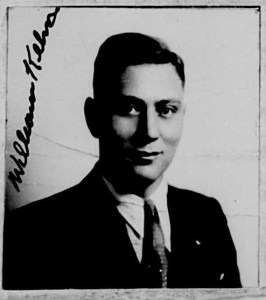
[“William Kelm immigration photo, 1933”], Kansas City, Jackson, Missouri, United States records, National Archives, accessed 26 Jun 2025 through FamilySearch; William is twenty-six years old
William Kelm was the youngest and only surviving child of Julius Kelm and his first wife, Serafina Albert. He was born in Winnipeg on May 24, 1907, a year after his parents arrived from Volhynia (see this blog post). His birth registration names Josephine Herman as his mother (I had made a note in this 2020 blog entry about checking the original birth registration, and Josephine Herman is recorded as William’s mother and it is not a mistranscription of Serafina. Whether or not this was the mistake of the informant is unknown, but Serafina raised William until her death in 1910).[1]
On September 7, 1925, William, nineteen years old, took the train to St John, North Dakota, his destination, Hansboro, North Dakota.[2] His immigration records describe him as five feet and ten inches tall with dark brown hair and hazel or brown eyes, his “little finger on left hand crooked in second joint.”[3] He arrived in the United States as a farm labourer, but eventually became a landscaper and tree surgeon.[4]
[“William Kelm declaration of intention, 1933”], Kansas City, Jackson, Missouri, United States records, National Archives, accessed 26 Jun 2025 through FamilySearch
In 1933, William formally declared his intent to become a citizen of the United States for the second time. On this document, William states that he is married to Leora Anderson, born in Houghton, Michigan, in 1906.[5] William and Leora married in Minneapolis, Minnesota, on August 19, 1933.[6] The newlyweds lived in Minneapolis, Minnesota.[7] Discovering the identity of this first wife made me wonder if there was another William Kelm, but the date and place of birth matched, and the document also mentions William’s “crooked finger on left hand.”[8] Between 1933 and 1937, William and Leora lived in Minneapolis.[9] In 1938, the Minneapolis city directory lists Leora as working as a clerk and living alone at 2313 Colfax Avenue, and that William had moved to St Paul, Minnesota.[10] Leora died on June 13, 1939, in Washington (county), Minnesota, at the age of thirty-two.[11]
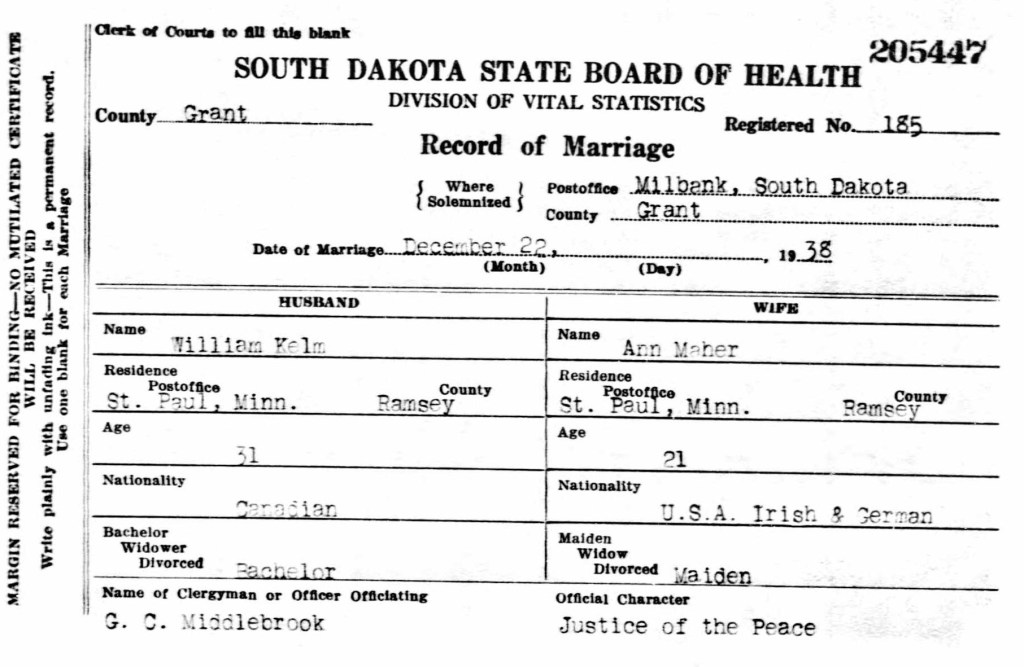
[“William Kelm and Ann Maher marriage record, 1939”], South Dakota, U.S., Marriages, 1905-2017, South Dakota Department of Health, accessed 21 Dec 2021 through Ancestry
When William married his second wife, Ann Maher, in December 22, 1938, the marriage record indicates that William is a bachelor and neither divorced nor widowed.[12] William and Ann lived in St Paul and had three daughters: Janet Lee (born 1939), Judith Ann (born 1945), and Joette Marie (born 1951). William and Ann divorced in 1978.[13]
William became a United States citizen on April 24, 1940.[14] He died February 15, 1991, in Ramsey, Minnesota.[15] He is buried in Sunset Memorial Park Cemetery in Minneapolis.[16]
William Kelm (b. 24 May 1907 in Winnipeg, Manitoba, Canada; d. 15 Feb 1991 in Ramsey, Minnesota, USA)
m. (19 Aug 1933 in Minneapolis, Minnesota, USA) Leora Marie Anderson (b. 28 Oct 1906 in Houghton, Michigan, USA; d. 13 Jun 1939 in Minnesota, USA)
m. (22 Dec 1938 in Grant, South Dakota, USA) Ann Mary Maher (b. 14 Jan 1917 in Osakis, Minnesota, USA; d. 20 Apr 2000 in Saint Paul, Minnesota, USA)
Janet Lee Kelm (b. 06 Oct 1939 in Ramsey, Minnesota, USA)
Judith Ann Kelm (b. 13 Jul 1945 in Ramsey, Minnesota, USA) m. (11 Jun 1966 in Ramsey, Minnesota, USA) Richard Wilton Lofstrand (b. 06 Jan 1940 in Minneapolis, Minnesota, USA; d. 14 Jan 2012 in Bartlett, Illinois, USA)
Joette Marie Kelm (b. 08 Jul 1951 in Ramsey, Minnesota, USA)
[2] [“William Kalm, 1925”], U.S., Records of Aliens Pre-Examined in Canada, 1904-1954, National Archives, accessed 21 Dec 2021 through Ancestry
[3] [“William Kelm declaration of intention, 1926”], North Dakota, U.S., Naturalizations, 1873-1952, State Historical Society of North Dakota, accessed 21 Dec 2021 through Ancestry; “William Kalm, 1925”
[4] [“William Kelm declaration of intention, 1926”]
[5] [“William Kelm declaration of intention, 1933”], Kansas City, Jackson, Missouri, United States records, National Archives, accessed 26 Jun 2025 through FamilySearch
[6] [“William Kelm and Leora Anderson marriage record, 1933”], index only, Minnesota, U.S., Marriages from the Minnesota Official Marriage System, 1850-2022, Minnesota Association of County Officers, accessed 26 Jun 2025 through Ancestry
[7] [“William Kelm declaration of intention, 1933”]
[9] [“Leora M. Kelm and William Kelm city directory listing, various years”], Minneapolis, Minnesota, City Directory, U.S., City Directories, 1822-1995, accessed 27 Jun 2025 through Ancestry
[10] [“Leora M. Kelm city directory listening, 1938], Minneapolis, Minnesota, City Directory, 1938, U.S., City Directories, 1822-1995, accessed 27 Jun 2025 through Ancestry
[11] [“Mrs Leora Marie Kelm death record, 1939”], index only, Minnesota, Death Index, 1908-2002, Minnesota Department of Health, accessed 27 Jun 2025 through Ancestry
[12] [“William Kelm and Ann Maher marriage record, 1939”], South Dakota, U.S., Marriages, 1905-2017, South Dakota Department of Health, accessed 21 Dec 2021 through Ancestry
[13] “Divorce Index 1976 Thru 1979,” Vital Record Information System, Minnesota Department of Health, accessed 22 Dec 2021 through Ancestry
[14] “No. 4650067,” Minnesota, U.S., Federal Naturalization Records, 1896-1989, accessed 21 Dec 2021 through Ancestry
[15] [“William Kelm death record, 1991”], index only, Minnesota, Death Index, 1908-2002, accessed 22 Dec 2021 through Ancestry
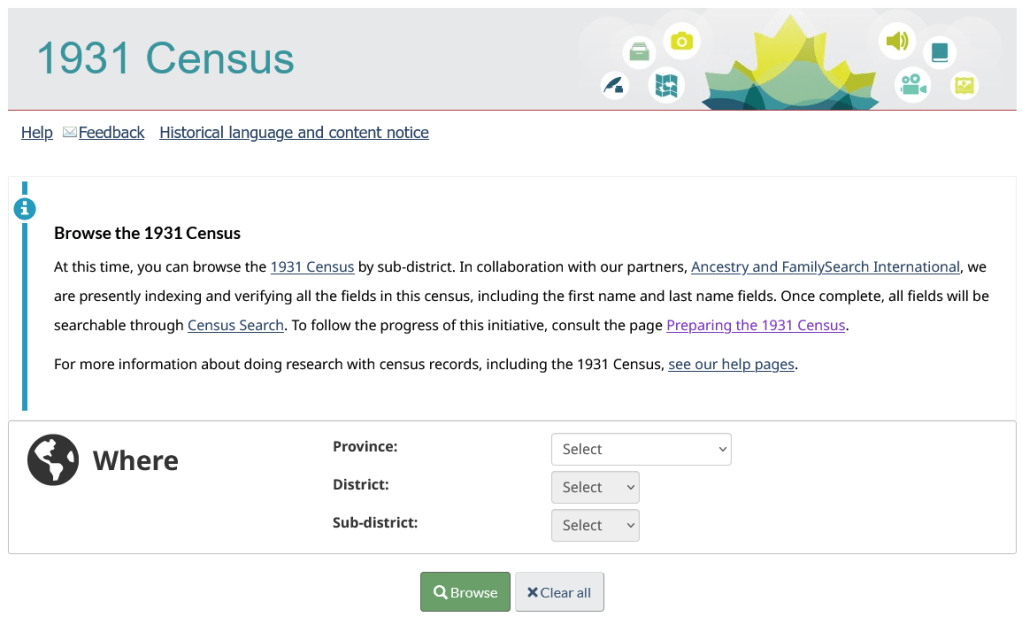
Like many other genealogists, I have been waiting and waiting for the 1931 Census of Canada to be released to the public (a census is released 92 years after being taken) by Library and Archives Canada. The digitized images have yet to be indexed for searching, but I am impatient and thought I would peruse. You can read “Preparing the 1931 Census” to learn more about the process of digitizing and making the census public. Click the screenshot below to browse the 1931 census:
I know from the 1921 Census of Canada and 1926 Census of Manitoba, Saskatchewan, and Alberta that my great-grandparents, Julius and Martha (Kirsch) Kelm, moved from their homestead in Camper to Winnipeg between 1921 and 1925. Forgetting that, in 1926, they technically lived in West Kildonan (according to the Winnipeg Tribune (17 Dec 1929), their part of Matheson Avenue joined Winnipeg after 1929 in order to obtain better sewer service), I browsed enumerated families in Winnipeg North. After revisiting the 1926 census, I realized my mistake and browsed Selkirk (district) > West Kildonan. I used Google Maps to look up random streets on various pages to pinpoint if I was close to where I knew the family was living at 557 Matheson Avenue (557 Armetta Avenue in 1926). I finally found them.
According to the census, Julius (who goes by John) and Martha, and their children, Edward, Robert, Hilda (Hulda), and Daniel are living at 557 Matheson Avenue. Two children are missing from the household: William, who immigrated to the United States in 1925, and Hannah, who is newly married to Paul Lucyk in 1931. As occupation was missing from the 1926 census, it is interesting to see it here. According to the 1931 census, Julius has resumed his work before moving to his homestead in 1911–”sewers”–and his son, Edward (age 20), works alongside him.
Click here for the first part of this post, Finding Serafina Kelm. My search for how the Kelm family ended up in Winnipeg led me to explore the family connections that made it possible. I also love a good puzzle.
Photograph of the Kelm family, around 1909 or 1910; scan courtesy of P. Reakes
When Serafina was twenty-two years old, she and her husband, Julius Kelm, and two children left their home in or near Hofmanofka, Novograd-Volynsk, Volhynia, for Winnipeg. What information we know about Serafina is from her arrival in Winnipeg in 1906 and her death four years later. Shortly before her death, Serafina posed for a photograph; she is blue-eyed and serious, wearing a black dress and a hat full of flowers. Posing alongside her are her husband, Julius; her daughter, around six years old, Olga; and her youngest son, William.
Serafina’s daughter, Olga, was born July 21, 1903, in Hofmanofka and baptized August 10 in nearby Neudorf.[1] The parents in this record are Julius Kelm and “Seraphine Albert.” There is a record of a “Serafine Albert” born June 17, 1883, in Maksimilianowka, Novograd-Volynsk, to Georg Albert and Marianna Abram.[2] The year of birth matches that of the aforementioned Serafina Albert. Additionally, Maksimilianowka was around twenty kilometers from Neudorf.
The month after their arrival in 1906, Julius and Serafina were enumerated in the 1906 Census of Manitoba, Saskatchewan, and Alberta. They lived at 677 Ross Street, Winnipeg, with “H. Albert,” thirty years old and having arrived in Canada in 1901.[3] A possible relative of Serafine’s, he may have helped them emigrate. Finding out who “H. Albert” is may flesh out the Kelm family’s immigration story, as well provide more insight into who Serafina was.
According to the Society for German Genealogy in Eastern Europe, Georg Albert and Marianna Abram also had a son, Julius Albert, born in 1862 in Augustopol, Lodzkie, Poland, who immigrated to Canada in 1906.[4] His family is found in the 1911 Census of Canada living on their homestead (31-51-24-W4) in Strathcona, Alberta (now merged with Edmonton).[5] Because family often lived close to one another, a search for any other Albert surname was conducted in the Strathcona area. According to the 1911 Census of Canada, Herman Albert and his family lived next to Julius at 31-51-25-W4, though they would be found in Township 43 in the 1916 Canada Census of Manitoba, Saskatchewan, and Alberta.[6] Additionally, Herman and his wife, Paulina Wilde, were possibly still living in Winnipeg in 1911. Three of their children were born in Winnipeg in 1908, 1910, and 1912.[7] Paulina’s place of birth was “Johannesdorf (Solomiak),” which was just seven kilometers north of Maksimilianowka.[8] Finally, Herman and Paulina also had a daughter named Seraphina, whose preferred name was Sarah. Serafina, an unusual name based on my observations, was a popular name in the family.
Looking at the facts, Herman Albert is likely the H. Albert living with Julius and Seraphina in 1906 and Serafina Albert is the same “Serafine” born in Maksimilianowka. Herman’s wife and three children joined him in Winnipeg in October of 1906, so he could have been erroneously marked as single in the 1906 census.[9] His death record does not reveal his parents’ names, if they were the same as Julius’ and Serafina’s. Herman died of “tertiary syphilis” in 1925.[10]
[1] “[Olga Kelm birth record]” from Volhynia Archives Birth Indexes – 1900-1918, accessed 12 Jun 2021 through Society for German Genealogy in Eastern Europe
[2] “[Serafine birth record]” from Volhynia Archives Birth Indexes – 1900-1918, accessed 12 Jun 2021 through Society for German Genealogy in Eastern Europe
[3] 1906 Census of Manitoba, Saskatchewan, and Alberta, Library and Archives Canada, accessed 13 Jun 2021 through Ancestry
[4] Master Pedigree Database, accessed 18 Jun 2021 through Society for German Genealogy in Eastern Europe
[5] 1911 Census of Canada, Library and Archives Canada, accessed 13 Jun 2021 through FamilySearch
[6] 1916 Canada Census of Manitoba, Saskatchewan, and Alberta, Library and Archives
[7] “[Herman Albert and Wilhelm Albert birth information]” in Manitoba Vital Statistics Agency database index, accessed 13 June 2021; 1916 Canada Census of Manitoba, Saskatchewan, and Alberta, Library and Archives Canada, accessed 13 June 2021 through Ancestry
[8] “Pauline Albert (Wilde)” in King/Burton Family Tree [Ancestry family tree], accessed 18 Jun 2021 through Ancestry
[9] “Panline Albert” in Canada, Arriving Passengers Lists, 1865-1935, Library and Archives Canada, accessed 11 June 2021 through Ancestry
[10] [“Herman Albert Registration of Death, 1961”], Provincial Archives of Alberta. Digital copy emailed 29 Mar 2021
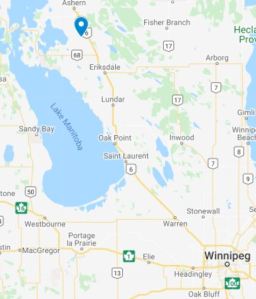
Map showing Winnipeg (bottom right) and the location of the Kelm homestead near Camper (top left)
When Robert Bergner arrived in Camper on June 13, 1910, to look for a homestead, “there was no town, only a few tents.” Though described as historically having been “an uninhabited wilderness” or having few permanent settlements by the late eighteenth century,[1] the Interlake region of Manitoba, between Lake Manitoba and Lake Winnipeg, was home to the Ojibway, Cree, and Oji-Cree, as well as the Metis.[2] From 1670 to 1869, the region was part of Rupert’s Land, which comprised eight million square kilometers and was monopolized by the Hudson’s Bay Company. In 1869, the Government of Canada purchased Rupert’s Land from the HBC, who claimed ownership, for 1.5 million dollars. The transfer was finalized in 1870, the same year Manitoba joined Canada.
Starting in 1871, the Government of Canada established townships in a grid system called the Dominion Land Survey. Beginning in 1872, The Dominion Land Act guided the administration of land for homesteading, among other uses. To boost prairie settlement, the government advertisement homesteads in 160-acre increments. After paying the ten-dollar application fee, the homesteader had three years to break and farm thirty acres of land, reside on the homestead for more than six months out of the year, and build a house and barn.[3] Once these requirements were fulfilled, the homesteader would receive the title for the land and, if he was not already a British subject, become naturalized.[4]
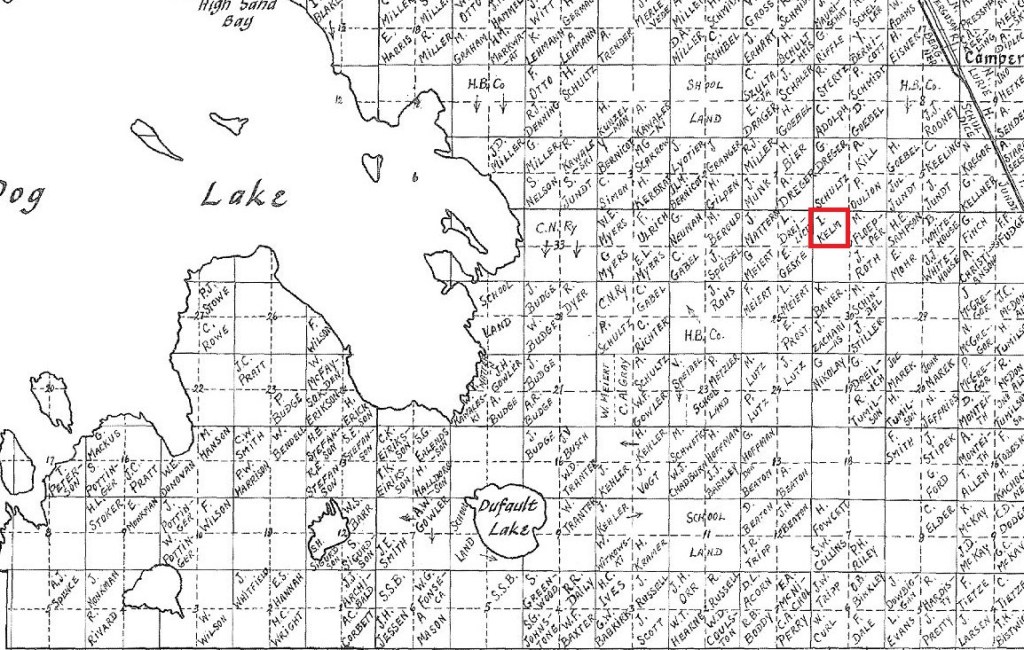
Julius Kelm applied to the Government of Canada for a homestead on May 1, 1911.[5] The 164 acres was located along what is now Edison Road, approximately halfway between Highway 6 and Dog Lake, and six kilometers from Camper.[6] According to an interview with Julius and Martha (see Stories From the Past), there were around twenty other German families living in the area around Camper. The majority of Germans settled north and east of Dog Lake and west of Camper: “Many of the later [German] settlers–from the Russian Ukraine–came to be near the earlier German settlers and took up stonier, more heavily-wooded land.”[7]
“[Julius Kelm entry in Homestead Grant Register, application for homestead 419750]” in Manitoba, Saskatchewan and Alberta, Canada, Homestead Grant Registers, 1872-1930, Library and Archives Canada, accessed 05 Jun 2021 through Ancestry
Julius likely traveled the 165 kilometers from Winnipeg to Camper alone to look at available land before applying for it. There were few roads during that time; scouting homesteaders only had “a map from the Land Titles Office, showing the township lines, which were just lines just cut through the bush; [they] walked through swamps waist deep in water.”[8] Julius would have returned to Winnipeg for his family. Anna Markwart recalls that, in 1909, the Markwart family “packed up their belongings, loaded them into a freight car and came by rail as far Camper [as] that was as far as the railway went at that time. They had to stay in the freight car while Henry [Markwart] walked seven miles [eleven kilometers] to the homestead to see if he could get the only neighbor to lend him a wagon to move the family to the new homestead.”[9] Julius had selected land “in the twenty-third township, in the sixth range, west of the principal meridian,” or homestead 419750.[10]
The first of the homesteading work occurred in early May. The land would have to be broken and ploughed first, and this was most effectively accomplished between June and August. Many accounts of homesteading in the Camper area begrudge the “mountains of stones”; in order for land to be cleared for farming, “stumps and stones” had to be removed and “every time the land was ploughed there would be more stones.”[11] After this, a house and stable would be built. Anna Markwart remembers that her husband’s family “lived in a makeshift shelter until they could cut enough logs for a small log house.”[12]
Homesteading on the prairie was often treacherous; wild animals harassed and feasted on livestock, even getting into the barns.[13] The year Julius secured his homestead, a timber, or grey, wolf was terrorizing livestock “from Camper to Gypsumville” and farmers would stay up at night with their guns waiting for it.[14] The prairie, immense and seemingly never-ending, could also be a lonely place. Debbie Hoffman describes her grandmother’s, Martha Miller’s, first years in her new home: “Martha wasn’t used to the big forests and swamps of the Interlakes […] The fright and loneliness almost drove her out of her mind.”[15]
Map of homesteads located within Township 23, east of Dog Lake. Julius Kelm’s neighbors included the Drailich family, whose daughter Adeline “Lena” married Edward Kelm, and Mattern and Geske families; courtesy of Taming a Wilderness: A History of Ashern and District by Ashern Historical Society
Julius and Martha had four children while living near Camper: Hannah (born March 4, 1913), Robert (born May 12, 1914), Hilda (born June 22, 1915), and Daniel (born May 17, 1917). The place of birth for the first three children is the Rural Municipality of Coldwell while the place of birth for Daniel is Camper.[16] In the 1916 Census of Canada, the family identified as Russian as World War One raged in Europe, the German families around them also identifying as Russian.[17] Julius (as John Kelm) also appears in the 1916 Census of Canada living with the Rempel family at 814 Bannatyne in Winnipeg as a lodger. He may have returned to Winnipeg for part of the year to find extra work to sustain his homestead.[18] Later that year, in December, the oldest daughter, Olga, thirteen years old, died. No record has been found of her death and burial.
It took Julius and Martha more than three years to earn their papers. Julius owned the land by February 15, 1917, when inspectors verified that he had fulfilled the requirements.[19] Sworn statements from two neighbors were required.[20] When his neighbor John Mattern, obtained the patents to his land on May 20, 1918, Julius testified: “Those that witnessed this were John Kelm of NW 31-23-6W and Edward Geske of SE 36-23-7W.”[21] In the 1921 Census of Canada, Julius is the owner of his three-room home.[22]
[Homestead No. 419750 grant]” from Letters Patent, Canada, Department of the Interior, accessed 05 Jun 2021 through Canadiana Heritage
But farming proved to be too difficult; the Kelm family “had the worse land, unsuitable for farming” (see Stories From the Past). Frank Tennenhouse, whose family moved to Camper in 1911, writes that there was little government support for new farmers and there were few nearby farmers who had settled there long enough who could help newcomers.[23] Tennenhouse remembers that his father had “visited the location and had thought it was wonderful because there was plenty of hay for cattle and trees for wood. What he did now know was that the hay was low quality swamp and the soil was stony and infertile.”[24] Shannon Stunden writes, “Many […] newcomers settled in the less productive lands […] in eastern or interlake Manitoba.”[25] Most families returned to Winnipeg.
[1] James Morton Richtik, “A Historical Geography of the Interlake Area of Manitoba [thesis]” from Manitoba Heritage Theses, University of Manitoba, 1964, p14
[5] “[Julius Kelm entry in Homestead Grant Register, application for homestead 419750]” in Manitoba, Saskatchewan and Alberta, Canada, Homestead Grant Registers, 1872-1930, Library and Archives Canada, accessed 05 Jun 2021 through Ancestry
[13] Dugald Women’s Institute, Springfield: 1st Rural Municipality in Manitoba, 1873-1973, Dugald, MB: Dugald Women’s Institute, 1974, p34, accessed through Internet Archive
[14] Interlake Pioneers, Hardship and Happiness, Steep Rock, MB: Interlake Pioneers, 1974, p64
[19] “[Homestead No. 419750 grant]” from Letters Patent, Canada, Department of the Interior, accessed 05 Jun 2021 through Canadiana Heritage; the stamp in the homestead grant register indicates February 7, 1917
[20] “Manitoba Crown Land and Homestead Records (National Institute) [wiki]”
[21] Ashern Historical Society: The Next Chapter; A History of Ashern and District, Ashern, MB: Ashern Historical Society, 2008, p319, accessed 06 Jun 2021 through University of Manitoba Digital Collections
[22] 1921 Census of Canada, Library and Archives Canada, accessed 08 Jun 2021 through Ancestry
[23] Frank Tennenhouse, “Photocopy of unpublished manuscript, “Seventy Five Years of Farming in Manitoba: A Collection of Stories of Life on the Farm from Two Generations of the Tennenhouse Family,” Tennenhouse Family fonds, University of Manitoba Archives, accessed 06 Jun 2021 through University of Manitoba Digital Collections
[25] Shannon Stunden Bower, Wet Prairie: People, Land, and Water in Agricultural Manitoba, Vancouver: University of British Columbia Press, 2011, p35, accessed 08 Jun through Google Books
On behalf of his children, Derek and Christine: Happy Birthday to Wallace (Wally) Kelm. Today my uncle would have been seventy-five years old. You are welcome to leave comments and memories.
The painting below is by Christine Kelm of her dad pointing at Treasure Island in Mindemoya Lake on Manatoulin Island, Ontario.
As much as I am thankful for the family tree work of other family historians, I am often wary of copying without checking sources. One of my fears, for example, is that I will record incorrect information and have that replicated in other Ancestry family trees. I’m not implying that others’ work is usually incorrect; I’m just a proponent of verifying information with records.
In my search of where the Kelms of Borki originated, I’ve taken information from public family trees and user-contributed information in databases like GEDBAS and FamilySearch (Family Tree) that indicate that their forefathers lived in Netzbruch (Przynotecko), Friedeberg, Brandenburg, Prussia. However, I can’t find records that confirm this information. Because of this, my Direct Ancestors page separates Andreas Kelm and Anna Krystyna Jess, my known great-great-great-great-grandparents–the Borki patriarch and matriarch–from the Kelms of Netzbruch. The Netzbruch Kelms’ genealogies are well-documented from 1645, but, as far as I know, there is no link… yet. If Kelm genealogists have discovered this link, I would be very excited to see it.
I am revisiting what information I have collected about the first generation of Kelms in Borki (the children of Andreas Kelm and Anna Krystyna Jess) and reviewing databases like Geneteka and Society for German Genealogy in Eastern Europe to both verify relationships and double-check for the overlooked details, or the details that don’t usually make it into searchable indexes. An indexed marriage record, for example, usually includes names, parents’ names, place names, and dates. But what else can we find in the record itself?
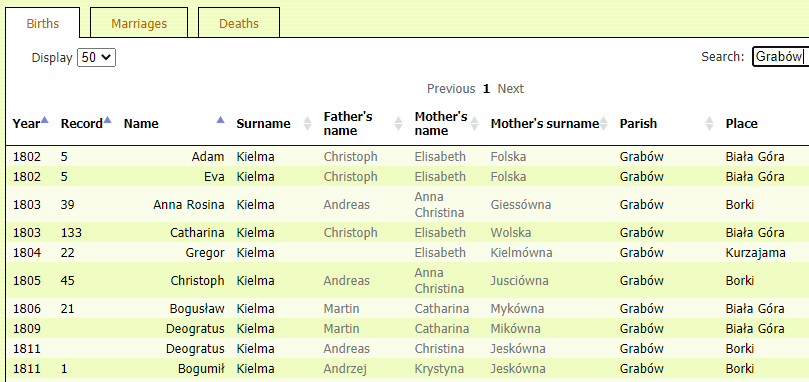
Searching for indexed “Kelm” records in SGGEE; results with Andreas Kelm and Anna Christine Jesse or Gesse as parents
Searching for indexed “Kielma” records in Geneteka (Grabow parish); results with Andreas Kelm and Anna Krystyna Jesse (or Polish variants of surname) as parents
According to the above results, as well as additional marriage records, Andreas and Anna Krystyna had eight known children1:
Anna Luisa (Ludwika) Kelm (b. 1797 in Wrzesnia, Posen, Prussia; d. 25 Aug 1854 in Borki, Lodzkie, Poland)
Andreas Kelm (b. 21 Aug 1801 in Borki, Lodzkie, Poland)
Anna Rosina Kelm (b. 19 Mar 1803 in Borki, Lodzkie, Poland)
Christoph Kelm (b. 28 Mar 1805 in Borki, Lodzkie, Poland; d. 08 Dec 1874 in Pokrzywnica, Lodzkie, Poland)
Anna Marianna Kelm (b. 12 Jan 1807 in Borki, Lodzkie, Poland)
Daniel Kelm (b. 1808 in Dabie, Wielkopolskie, Poland; d. 29 Jan 1858 in Kadzidlowa, Lodzkie, Poland)
Bogumil (Gottlieb) Kelm (b. 24 Dec 1810 in Borki, Lodzkie, Poland)
Deogratus Kelm (b. 24 Dec 1810 in Borki, Lodzkie, Poland)
1Some family trees list Peter Kelm, but I have been unable to confirm
Daniel Kelm, my direct ancestor, appears to have been born just over the border from Lodzkie in Wielkopolskie. I have his 1833 marriage record and, having not asked for help translating it, can only see Sobotka (Kolo County), the place of marriage, and Borki Colony, the place where he lives and where his parents lived.
The marriage record of Daniel’s oldest sibling, Anna Luisa Kelm (also spelled Anna Lowisa or Ludwika) provides an interesting clue.
[“Ludwika Kielm and Bogumil Krygier marriage record, 1815”] from Akta stanu cywilnego Parafii Rzymskokatolickiej w Grabowie, accessed through Polskie Towarzystwo Genealogiczne (Polish Genealogical Society) on 31 Oct 2020.
Monica Kucal helped me extract the following information:
The bride name is written Ludowika, Lovis in brackets, and then Ludwika. She was a daughter of late Andrzej Kielm2 and still alive Krystyna Jessowna [may come from Jess surname], age 18, based on the birth certificate from Wrzesnia church [that means that she was born there], living with her mother in Borki.
2 According to this record, Andreas Kelm died before 1815. His youngest sons, Bogumil (Gottlieb) and Deogratus, were born December 1810, which gives us a narrower death date estimate of between 1810 and 1815.
Is it possible Andreas, Anna Krystyna, and little Anna Luisa (she was four years old when her brother, Andreas, was born in Borki) came to Borki from Wresnia (around 130 km west of Borki)? We are equipped with another clue in figuring out the gap between the Borki Kelms and, if the speculation proves correct, the Netzbruch Kelms.
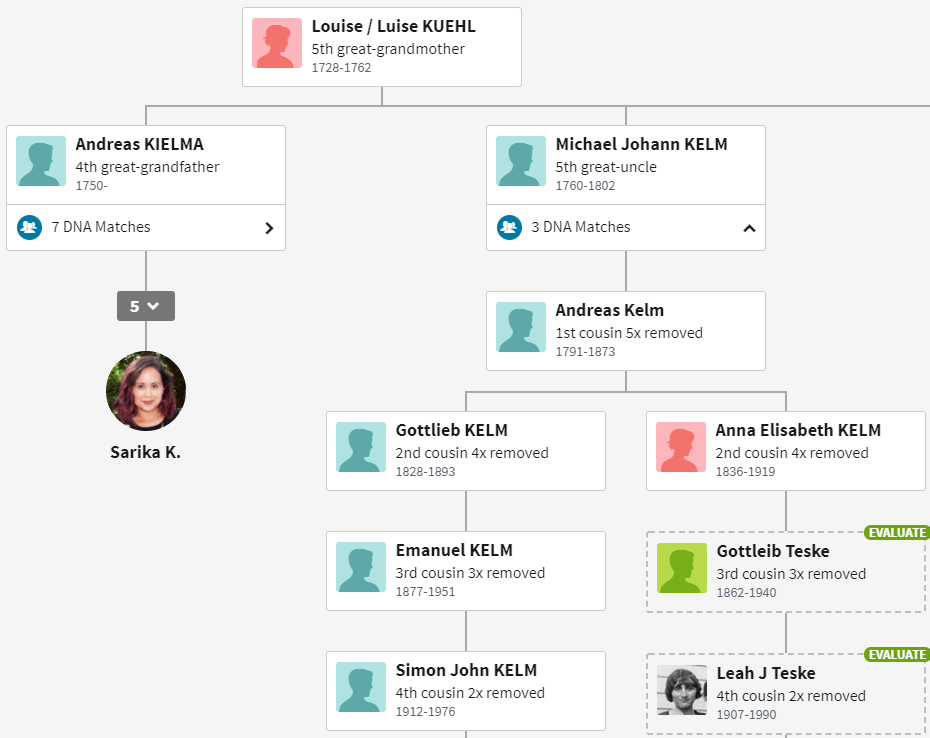
Finally, having done the Ancestry DNA test and checking their ThruLines feature (which, I should note, relies on users’ family trees being accurate), I can say that I may have found a link (see below) to Christian Kelm and Louise Kuehl of Netzbruch, the speculated parents of Andreas Kelm. Their son, Michael Kelm, was born in Exin, West Prussia, which is Kcynia, Wielkopolskie, Poland, today. Kcynia is around 80 km north of Wresnia. Our search continues.
Happy Friday, everybody. Thank you to Hendrik Wendland for sharing the following death record in his Ancestry family tree and to Teresa Eckford and Valerie Baginski for help extracting names and confirming information.
My great-great-great-great-grandmother (whew), Anna Krystyna Jess, was married to Andreas (Andrzej) Kelm. Variants of her surname that I have found include Jusciowna, Jeskowna, Jesse, Jeske, Gesse, and Guz. I am trying to link Andreas and Anna Krystyna, who lived in Borki, Lodzkie, Poland, in the eighteenth century, to recorded Kelms who lived in Netzbruch (Przynotecko), Brandenburg, Prussia, in the seventeenth century. I asked for help with this record with the hope there was information about her family and origins as I believe Andreas and Anna Krystyna were the first generation to live in Borki, Leczyca, Poland, area. Fun fact: “Borki” seems to mean “residence or farm,” according to Meyers Gazetteer.
[“Anna Krystyna Kielm death record, 1831”] from Archiwum Państwowe w Poznaniu (Poznan State Archives), accessed through Szukajwarchiwach.pl on 22 Oct 2020.
Date of record: Dabie, 19 March 1831, 10 a.m. Witnesses: Krysztof Kielm, farmer, age 26, son of the deceased, and Michał Kriger, farmer, age 41, both residing in the colony of Borek [Borki] Deceased: there on the 18th of March this year at 3 a.m. Anna Krystyna Kielm nee Jess died, age 56
Although there doesn’t appear to be new information, I am always excited to confirm information by looking at the records themselves–and thankful that archives and volunteers index, translate, digitize, and make these records accessible.
My great-grandmother, Martha Kirsch, was born in April 1881 in Lutsk, Volhynia, Russia, to Samuel Kirsch (Wisniewski in Polish) and Karolina Wurfel. As all of the Kirsch children born between 1877 and 1897 were born in Ludwischin (village), Lutsk (district), Volhynia (region), Russia, it is possible Martha was also born there.
Note: The following stories were written by a Kelm family member who was close to Julius and Martha. They were both interviewed and their stories retold revealing insights into their personal lives, marriages, births, and deaths. The stories were transcribed by Phyllis Kelm Reakes with permission to share from the original author.
Stories from the Past: Martha Kirsch (Part 3)
Martha came from a very poor family of 19 children. She recalls her father, [Samuel], as an old man with a beard, who married three or four times. Martha’s siblings Julia, Carl and Daniel all immigrated to Canada, too.
Martha said that there were so many children that at night her parents had to make a roll call to see that all the children were accounted for and none were missing. One evening one of the children was missing. The parents and the older children started to search for him. They found him sleeping in the outside oven. It was warm in the oven and he had crawled inside and fell asleep there.
The Kirsch farm was situated next to a school but the Kirsch children did not go to school as they were too poor and had to work. Martha’s job was herding cows. She would go outside all day in the field watching the cows and would hear the children singing in the school house when the windows of the school house were open. She sang along with them and soon she knew all the songs. At night she said she would sit on her father’s lap and sing the songs to him. He was amazed and asked her how she had learned the songs. She told him she had heard the children singing in the school house and learned the songs. This made her father very happy. Martha was very intelligent. She had an excellent memory. She never went to school but at age 30 while living in Camper, Manitoba she learned to read and write German from the minister that used to visit. She then taught all her children to read and write in the German language.
In Germany, the Remples were neighbours of the Kirsch family. They felt sorry for Martha and took her in. She worked for them as a domestic and they were very good to her. The Remples decided to come to Canada with their 12-year-old son, August. They asked Martha to come with them and she decided to immigrate with them to Canada.
About this same time Martha fell in love with a young man. They wanted to marry but he had to serve a year in the army first. She said that she could not wait for him as arrangements had been made for her to go to Canada with the Remples. The young man was very heartbroken. He told her that she would never be happy because she did not marry him, a man who truly loved her. Later, Martha learned that this young man had been killed in the army. She often told this story and over the years the words of her young man came back to haunt her. She did not have a happy marriage to Julius Kelm and although she loved her children she often wondered how her life could have been different if she had remained in Volhynia and had married her young soldier.
Mr. and Mrs. Remple, August Remple and Martha went to live at 868 Ballantine [Bannatyne] Avenue, Winnipeg. It is not certain if Martha’s sister, Julia, was already living in Winnipeg or whether she immigrated along with the Remples. Julia and August did not know each other in Germany [note: August and Julia Remple immigrated to Canada in 1890 and appear in the 1891 Census of Canada]. August Remple and Julia Kirsch eventually married each other. Also living in the house about this time was Martha and Julia’s brothers, Carl and Daniel, who worked for the CPR.
Mr. and Mrs. Remple were already fairly elderly. They had purchased a small farm at Oak Bank, which was not far from Winnipeg. Later, when Mrs. Remple was dying she only wanted Martha to look after her. Martha left her husband, Julius, and children to care for Mrs. Remple who died within a week. The house at 808 [Update, 31 May 2021: Possible this refers to 814 Bannatyne] Ballantine [Bannatyne] was a large two or three story home that was located close to the General Hospital [Winnipeg General Hospital, now Health Sciences Centre]. August Remple was a sewer contractor and had people working for him digging sewer lines for the City of Winnipeg. The Remples also had rooms rented out to boarders, most of whom worked at the hospital which was located nearby. Martha got a job working in the laundry room of the hospital. She would wash the hospital sheets on washboards and folded the clean laundry. She described herself as being quite happy. She had a real job for the first time in her life and was making her own money. She was quite content and had no interest in getting married.
This installment of “Stories from the Past” is a more personal version of the blog post I wrote from records and secondary sources. We can learn so much more from the people themselves.
Stories from the Past: The Move to Canada (Part 2)
Note: The following stories were written by a Kelm family member who was close to Julius and Martha. They were both interviewed and their stories retold revealing insights into their personal lives, marriages, births, and deaths. The stories were transcribed by Phyllis Kelm Reakes with permission to share from the original author.
Canada wanted immigrants and was aggressively advertising for people to come and settle in Canada. The Lutheran and Baptist church had ministers that acted as immigration agents. It was through the auspices of the Lutheran Church that Julius Kelm and others from Volhynia immigrated to Canada. Martha Kirsch and others from Volhynia came under the auspices of the Baptist Church. In each case they sold whatever they had to pay their fare to Canada and arrived with very little.
Julius and Serafina had one child that died in Russia [unconfirmed]. They came to Canada with the two remaining children, Olga and Gustav. They arrived in Quebec City in May 1904. Julius later would say that he came to Canada with nothing but 10 fingers [note: the ship manifest notes the Kelm family arrived with $5.00]. Julius said that when they arrived in Quebec City everything was in bloom. He and his family we glad to be in Canada. Those who they were travelling with told them that it was more beautiful in Winnipeg. He wanted to stay in Quebec City but was unable to do so as their designation was Winnipeg. They boarded the train along with the other immigrants they had come with and traveled to Winnipeg. Julius said that when they arrived in Winnipeg there was snow on the ground and the weather was very cold.












 Kelm History Blog