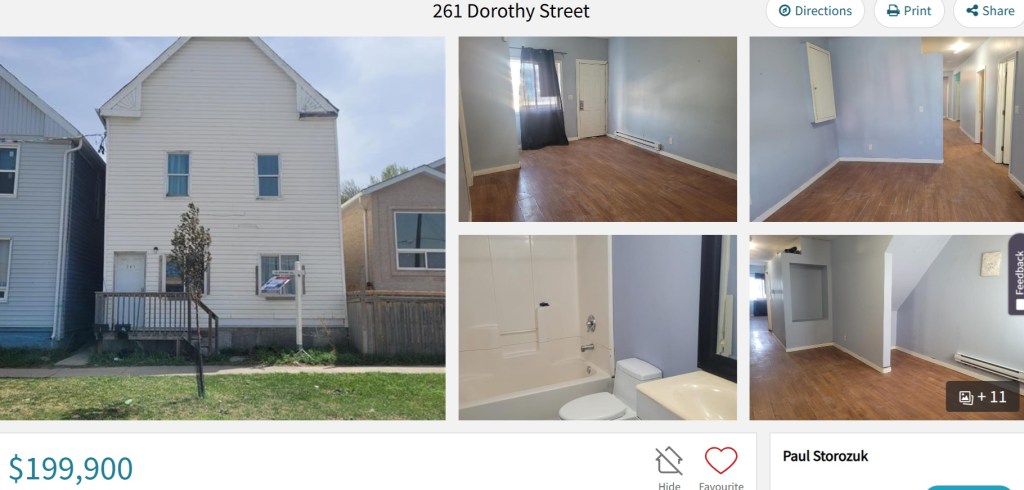
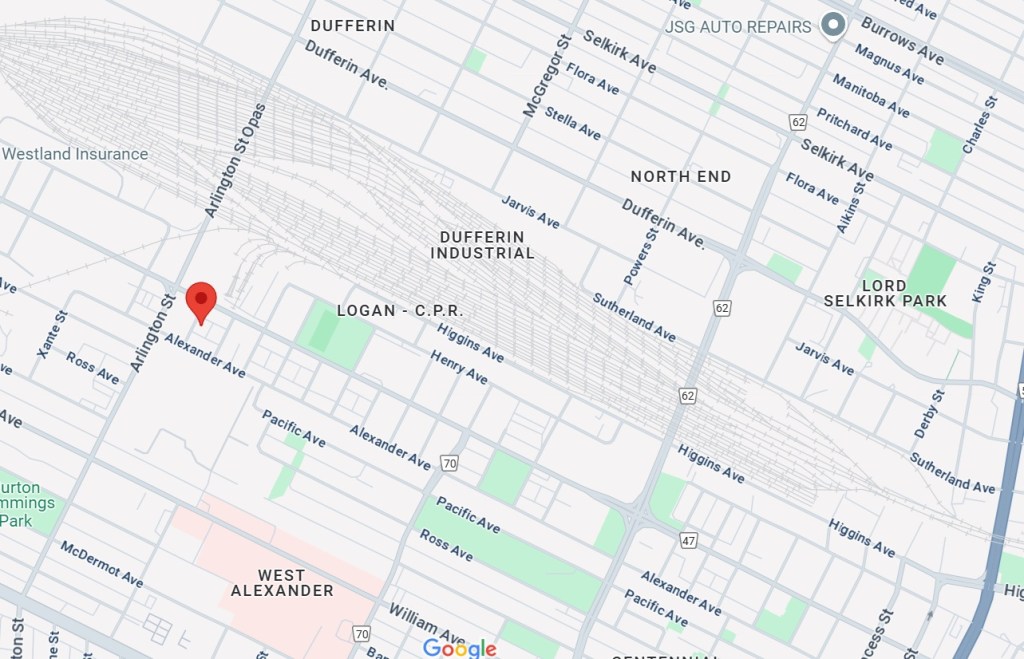
While working on my book, I accidentally found this house listing. For $199,900 CAD, you can buy 261 Dorothy Street (duplex) in Winnipeg, where my great-grandfather, Julius (John) Kelm lived with his first wife, Serafina, and their two children, William and Olga. The house, built in 1905, was mentioned in Serafina’s obituary when she died in 1907 (see Finding Serafina Kelm). When Julius and Martha married in 1910, they moved back to Dorothy Street, though the address is not mentioned (see Stories from the Past: To Marry or Not to Marry) and I could not find them living on Dorothy Street in the 1911 Census of Canada. Dorothy Street is just south of the Canadian Pacific Railway (CPR) yards and, historically, seemed to have been comprised of rooming houses. In the 1911 census, for example, 261 Dorothy Street housed 26 people.
Google Map of Dorothy Street with reference to the CPR railway yards in Winnipeg
In 2011, the City of Winnipeg’s Board of Adjustment reviewed (view PDF here) the proposed “redevelopment of the boarded up, burnt out, former rooming house into a two family dwelling unit.” According to the report, a fire on August 11, 2008, damaged the exterior walls, floors, and roof (you can see footage of the house in this video of fire crews extinguishing a fire at 257 Dorothy Street in 2015) and the building was placed on the Vacant Building Registry. While the interior might look very different than it did 118 years ago (the interior was apparently gutted in 2011), I think the opportunity to glimpse at the inside of the house now can still offer clues as to what it was like when our ancestors lived there (for example, see the little rooms off the hallway in the top right corner of the first image).
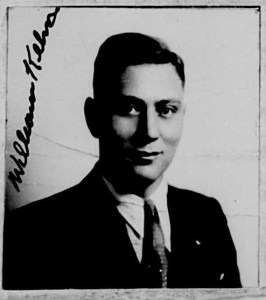
This section about William Kelm, my grandfather’s older half-brother, has been in progress for a long time. Like his father, William left his country of birth to pursue new opportunities. With my United States naturalization interview looming, I was excited to find new documents (and a photo!) about William and his intent to become a United States citizen. These new discoveries helped add more information to my very sparse biography.
Please excuse my citations. I am still working on making decisions about standardizing my citations.
[“William Kelm immigration photo, 1933”], Kansas City, Jackson, Missouri, United States records, National Archives, accessed 26 Jun 2025 through FamilySearch; William is twenty-six years old
William Kelm was the youngest and only surviving child of Julius Kelm and his first wife, Serafina Albert. He was born in Winnipeg on May 24, 1907, a year after his parents arrived from Volhynia (see this blog post). His birth registration names Josephine Herman as his mother (I had made a note in this 2020 blog entry about checking the original birth registration, and Josephine Herman is recorded as William’s mother and it is not a mistranscription of Serafina. Whether or not this was the mistake of the informant is unknown, but Serafina raised William until her death in 1910).[1]
On September 7, 1925, William, nineteen years old, took the train to St John, North Dakota, his destination, Hansboro, North Dakota.[2] His immigration records describe him as five feet and ten inches tall with dark brown hair and hazel or brown eyes, his “little finger on left hand crooked in second joint.”[3] He arrived in the United States as a farm labourer, but eventually became a landscaper and tree surgeon.[4]
[“William Kelm declaration of intention, 1933”], Kansas City, Jackson, Missouri, United States records, National Archives, accessed 26 Jun 2025 through FamilySearch
In 1933, William formally declared his intent to become a citizen of the United States for the second time. On this document, William states that he is married to Leora Anderson, born in Houghton, Michigan, in 1906.[5] William and Leora married in Minneapolis, Minnesota, on August 19, 1933.[6] The newlyweds lived in Minneapolis, Minnesota.[7] Discovering the identity of this first wife made me wonder if there was another William Kelm, but the date and place of birth matched, and the document also mentions William’s “crooked finger on left hand.”[8] Between 1933 and 1937, William and Leora lived in Minneapolis.[9] In 1938, the Minneapolis city directory lists Leora as working as a clerk and living alone at 2313 Colfax Avenue, and that William had moved to St Paul, Minnesota.[10] Leora died on June 13, 1939, in Washington (county), Minnesota, at the age of thirty-two.[11]
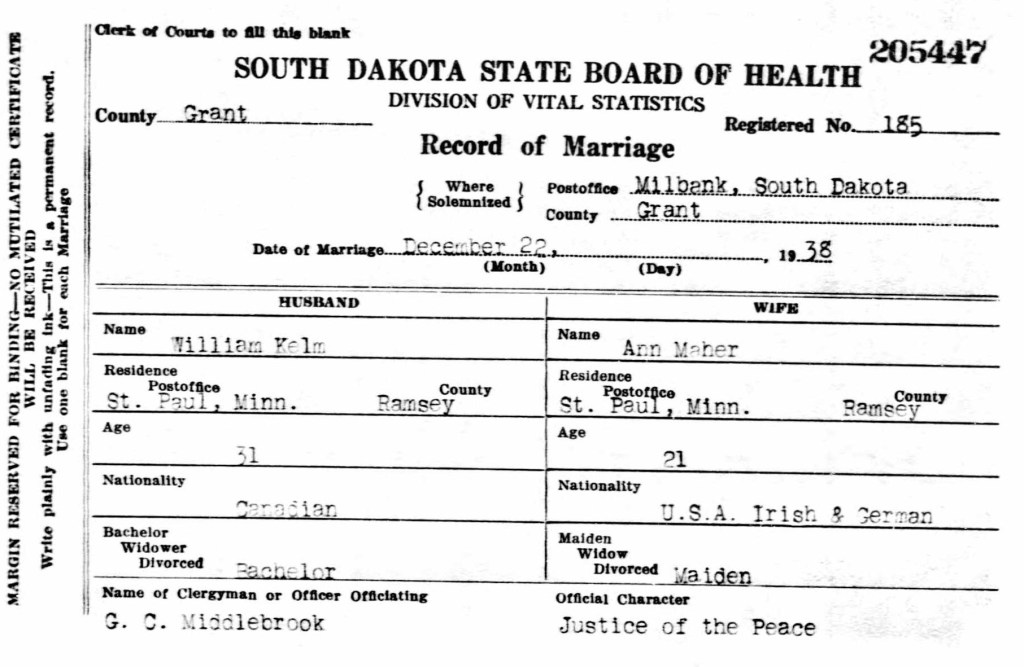
[“William Kelm and Ann Maher marriage record, 1939”], South Dakota, U.S., Marriages, 1905-2017, South Dakota Department of Health, accessed 21 Dec 2021 through Ancestry
When William married his second wife, Ann Maher, in December 22, 1938, the marriage record indicates that William is a bachelor and neither divorced nor widowed.[12] William and Ann lived in St Paul and had three daughters: Janet Lee (born 1939), Judith Ann (born 1945), and Joette Marie (born 1951). William and Ann divorced in 1978.[13]
William became a United States citizen on April 24, 1940.[14] He died February 15, 1991, in Ramsey, Minnesota.[15] He is buried in Sunset Memorial Park Cemetery in Minneapolis.[16]
William Kelm (b. 24 May 1907 in Winnipeg, Manitoba, Canada; d. 15 Feb 1991 in Ramsey, Minnesota, USA)
m. (19 Aug 1933 in Minneapolis, Minnesota, USA) Leora Marie Anderson (b. 28 Oct 1906 in Houghton, Michigan, USA; d. 13 Jun 1939 in Minnesota, USA)
m. (22 Dec 1938 in Grant, South Dakota, USA) Ann Mary Maher (b. 14 Jan 1917 in Osakis, Minnesota, USA; d. 20 Apr 2000 in Saint Paul, Minnesota, USA)
Janet Lee Kelm (b. 06 Oct 1939 in Ramsey, Minnesota, USA)
Judith Ann Kelm (b. 13 Jul 1945 in Ramsey, Minnesota, USA) m. (11 Jun 1966 in Ramsey, Minnesota, USA) Richard Wilton Lofstrand (b. 06 Jan 1940 in Minneapolis, Minnesota, USA; d. 14 Jan 2012 in Bartlett, Illinois, USA)
Joette Marie Kelm (b. 08 Jul 1951 in Ramsey, Minnesota, USA)
[2] [“William Kalm, 1925”], U.S., Records of Aliens Pre-Examined in Canada, 1904-1954, National Archives, accessed 21 Dec 2021 through Ancestry
[3] [“William Kelm declaration of intention, 1926”], North Dakota, U.S., Naturalizations, 1873-1952, State Historical Society of North Dakota, accessed 21 Dec 2021 through Ancestry; “William Kalm, 1925”
[4] [“William Kelm declaration of intention, 1926”]
[5] [“William Kelm declaration of intention, 1933”], Kansas City, Jackson, Missouri, United States records, National Archives, accessed 26 Jun 2025 through FamilySearch
[6] [“William Kelm and Leora Anderson marriage record, 1933”], index only, Minnesota, U.S., Marriages from the Minnesota Official Marriage System, 1850-2022, Minnesota Association of County Officers, accessed 26 Jun 2025 through Ancestry
[7] [“William Kelm declaration of intention, 1933”]
[9] [“Leora M. Kelm and William Kelm city directory listing, various years”], Minneapolis, Minnesota, City Directory, U.S., City Directories, 1822-1995, accessed 27 Jun 2025 through Ancestry
[10] [“Leora M. Kelm city directory listening, 1938], Minneapolis, Minnesota, City Directory, 1938, U.S., City Directories, 1822-1995, accessed 27 Jun 2025 through Ancestry
[11] [“Mrs Leora Marie Kelm death record, 1939”], index only, Minnesota, Death Index, 1908-2002, Minnesota Department of Health, accessed 27 Jun 2025 through Ancestry
[12] [“William Kelm and Ann Maher marriage record, 1939”], South Dakota, U.S., Marriages, 1905-2017, South Dakota Department of Health, accessed 21 Dec 2021 through Ancestry
[13] “Divorce Index 1976 Thru 1979,” Vital Record Information System, Minnesota Department of Health, accessed 22 Dec 2021 through Ancestry
[14] “No. 4650067,” Minnesota, U.S., Federal Naturalization Records, 1896-1989, accessed 21 Dec 2021 through Ancestry
[15] [“William Kelm death record, 1991”], index only, Minnesota, Death Index, 1908-2002, accessed 22 Dec 2021 through Ancestry
Happy New Year. Thank you to everybody who took the time to leave a comment or connected with me through email last year. My sincerest apologies if I have forgotten to respond. I blame the two small children in my house for my forgetfulness. If it was a inquiry about whether your Kelm family is related to mine, I likely set the email aside to investigate and then did not have the time to actually do that. You are welcome to remind me.
Return to Winnipeg
The story of how my great-grandparents, Julius (John) and Martha Kelm moved from Winnipeg to their homestead near Camper can be found here: Homesteading Near Camper, Manitoba, 1911-1921. This blog entry speculates about their return to Winnipeg after a decade homesteading on the prairie. I do not know their personal account except that they “had the worse land, unsuitable for farming” (see Stories From the Past). Their story follows the trajectory of many other homesteaders around Camper, so I thought I would explore other accounts.
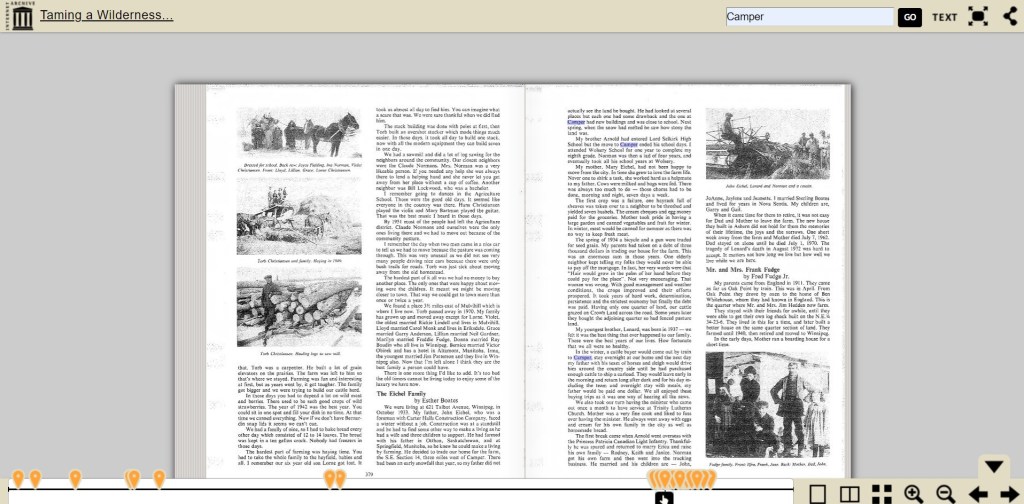
Searching digitized book for instances of “Camper”
Julius and Martha returned to Winnipeg between 1921, when the 1921 Census of Canada recorded them living near Camper, to 1924, when the obituary for Martha’s brother, Christian Kirsch, references her living in Winnipeg.[1] Between 1920 and 1923, bad harvests and falling wheat prices caused economic hardship for many Manitoba farmers and there was an exodus.[2] According to a Maclean’s article published February 1, 1922, “The high cost of producing and marketing the crop, with the heavy drop in prices, […] was responsible for the depression not only felt in Western Canada but reflected in every trade and industry in the Dominion.”[3]
Homesteaders often faced the devastation of fire, but, according to Borghil Olson, whose family homesteaded near Camper, one particular fire that “raged for weeks” caused many to grow restless and leave.[4] In August of 1920, a massive brush fire engulfed the Interlake region. Although the fire caused the most damage around where it originated near Mulville, about fourteen kilometers south of Camper, it had burned north through Camper and Ashern, driven by the season’s lack of rain. Newspapers described the fire’s arrival in Camper: “At Camper a stable and boarding house had been burnt down. The post office caught fire three times but was saved.”[5] In nearby Ashern, “chickens and calves had been roasted alive in the farmyards, and practically all crops destroyed.”[6]
“In 1920 the area was pretty well wiped out by bush fires, which raged for weeks. It was a very dry year, farmers lost most if not all the hay they had for winter as well as the spruce trees that could have been used for lumber. A terrifying experience. I recall we took all the children to Martin Johnson’s place where we figured they were safe from the fire. Mrs. Ben Kristianson and Mrs. Stein looked after the children, did the cooking, etc., while Mrs. Martin and I were out helping the men folk to save our homes and grain fields. Ben Kristianson’s home was a mile away from ours, and he made an agreement with the rest of the men, that if the fire did reach the spruce bluff near his home he would fire a rifle, and this would be a signal for the others to come to help fight fire. This particular day we were having lunch when a gun shot was heard, one of the women said “Ben must have shot a deer.” The men knew better, one by one they took off, to find Ben throwing water from a barrel alongside his house, onto the roof to put out the sparks flying from the spruce bluff close by, this way they did manage to save the home.”[7] – Borghild Olson, from Taming a Wilderness
In the 1926 Census of Manitoba, Saskatchewan and Alberta, the Kelm family except for the oldest son, William, were enumerated at 557 Armetta Avenue in the municipality of West Kildonan. In December of 1929, the “two blocks [of Armetta Avenue] west of McGregor Street, which included the Kelm home, prepared a petition to join the city of Winnipeg in order to obtain sewer service.[8] Armetta Street would later be renamed Matheson Avenue.[9] Julius and Martha would live at 557 Matheson Avenue for the rest of their lives.
Julius died February 27, 1959, at the Concordia Hospital, and is buried in Glen Eden Memorial Gardens in West Saint Paul, north of Winnipeg.[10] He was eighty years old. Martha became a member of the Mountain and Andrews Seventh-Day Adventist Church. She died at the St Boniface Hospital on July 20, 1965, at the age of eighty-four.[11] She is buried with her husband.
Courtesy of Find a Grave; photographed by Holly, 10 Oct 2021
Courtesy of Find a Grave; photographed by Holly, 10 Oct 2021
[1] “Christian Kirsch obituary,” 1924, newspaper source unknown, emailed 04 Oct 2024 by J. Hill
[2] Gerhard P. Bassler, The German Canadians, 1750-1937: Immigration, Settlement and Culture (St. John’s, NL: Jesperson Press, 1986), p99
[3] Jenkins, Charles Christopher, “The West Won’t Stay Down!,” 01 Feb 1922, from Maclean’s [magazine], accessed 21 Dec 2021 through https://archive.macleans.ca/article/1922/2/1/the-west-wont-stay-down [note: URL does not seem to be working any longer; access only through paywall (10 Jan 2024)]
[4] Borghild Olson, “Homestead Days,” from Taming a Wilderness: A History of Ashern and District Canadians (Ashern, MB: Ashern Historical Society, 1976), p84. Retrieved 09 Jan 2024 through University of Manitoba Digital Collections, http://hdl.handle.net/10719/2276635
[5] Free Press Prairie Farmer, 25 Jul 1920, accessed 22 Oct 24 through Newspapers.com
[10] “KELM,” Winnipeg Evening Tribune, 28 Feb 1959, accessed 18 Apr 2019 through University of Manitoba Digital Collections, http://hdl.handle.net/10719/1934469
[11] “MARTHA KELM,” Winnipeg Evening Tribune, 21 Jul 1965. Retrieved 18 Apr 2019 from University of Manitoba Digital Collections, http://hdl.handle.net/10719/2042634/
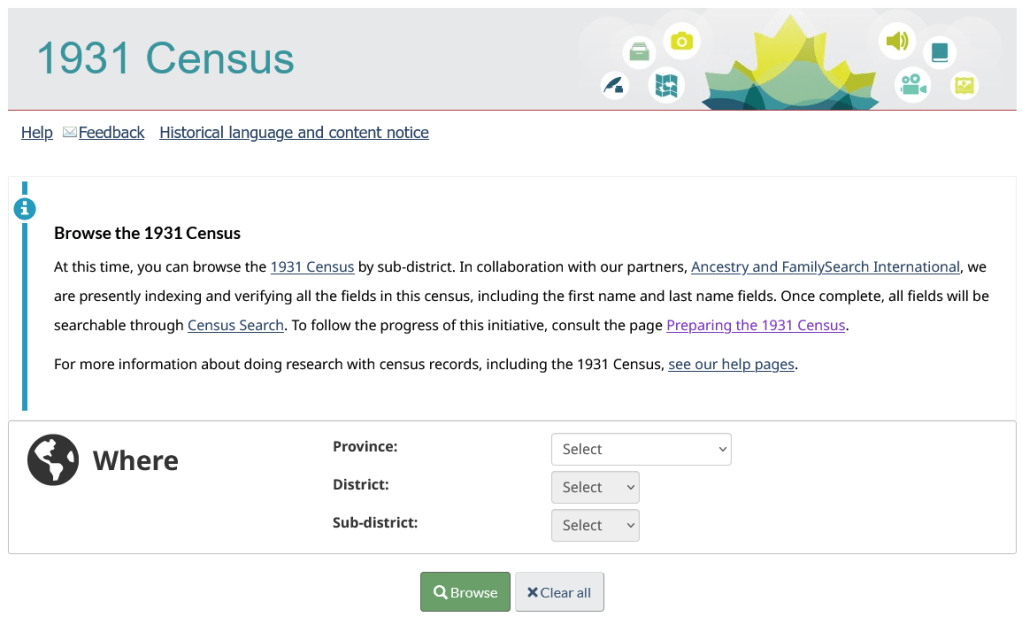
Like many other genealogists, I have been waiting and waiting for the 1931 Census of Canada to be released to the public (a census is released 92 years after being taken) by Library and Archives Canada. The digitized images have yet to be indexed for searching, but I am impatient and thought I would peruse. You can read “Preparing the 1931 Census” to learn more about the process of digitizing and making the census public. Click the screenshot below to browse the 1931 census:
I know from the 1921 Census of Canada and 1926 Census of Manitoba, Saskatchewan, and Alberta that my great-grandparents, Julius and Martha (Kirsch) Kelm, moved from their homestead in Camper to Winnipeg between 1921 and 1925. Forgetting that, in 1926, they technically lived in West Kildonan (according to the Winnipeg Tribune (17 Dec 1929), their part of Matheson Avenue joined Winnipeg after 1929 in order to obtain better sewer service), I browsed enumerated families in Winnipeg North. After revisiting the 1926 census, I realized my mistake and browsed Selkirk (district) > West Kildonan. I used Google Maps to look up random streets on various pages to pinpoint if I was close to where I knew the family was living at 557 Matheson Avenue (557 Armetta Avenue in 1926). I finally found them.
According to the census, Julius (who goes by John) and Martha, and their children, Edward, Robert, Hilda (Hulda), and Daniel are living at 557 Matheson Avenue. Two children are missing from the household: William, who immigrated to the United States in 1925, and Hannah, who is newly married to Paul Lucyk in 1931. As occupation was missing from the 1926 census, it is interesting to see it here. According to the 1931 census, Julius has resumed his work before moving to his homestead in 1911–”sewers”–and his son, Edward (age 20), works alongside him.
Perusing old (digitized) newspapers can be really fun. About the cancel my Newspaper.com subscription, I decided to do a quick search for any mention of “Kirsch” in 1900s Winnipeg newspapers. I came across an article in The Winnipeg Tribune, as well as published responses, about my great-grandmother’s sister-in-law, Emilie. As usual, my guide to Kirsch family history research is located here. You can read about Christian and Emilie (Reichert) Kirsch right here. As well, I updated the Direct Ancestors page to correct an error. I accidentally skipped a whole generation in the Kirsch section.
John Alexander Dowie, early 1900s, photo courtesy of State Library of South Australia
In the summer of 1903, Christian Kirsch’s second wife, Emilie, traveled to Zion City, Illinois, to ask the minister and faith healer, John Alexander Dowie, to cure her deafness. Three months after her return, The Winnipeg Tribune printed an interview with Emilie about her visit. In the interview, Emilie doubts Dowie’s purported healing abilities and accuses the minister, who had founded Zion City, an exclusively Christian community, in 1901, of exploiting the disabled and sick for their money.
Excerpt from The Winnipeg Tribune, 24 Oct 1903, accessed 07 Sep 2022 through Newspapers.com
Winnipeg Lady Goes to See Dowie (24 Oct 1903)
Has Not Retained Her Previous Faith in the So-called Restored Healer
He Wants Money Which She Was Not Able to Give –There Are Others
Mrs. Kirsch, of 541 Alexander Avenue, is one of the few Winnipeg women who have paid a visit to John Alexander Dowie, the modern Elijah, and since her trip to Zion City she does not hold the same opinion of him that she did before the journey to the Illinois town.
She is deaf in both ears, and a Mr. Smith, who lives on Bannatyne Avenue, heard of this, and had such faith in the “Restorer” that he kindly offered to pay Mrs. Kirsch’s expenses to Chicago in order that she might be cured. She also had great faith in the healing powers of Mr. Dowie, so she gladly accepted the offer. All this happened some three months ago, but she is not back in Winnipeg paying compliments to the “Restorer” in a way which would hurt the feelings of “Elijah III” if he could but hear them.
The tale as told by her trough an interpreter to a reporter for The Tribune was as follows:
HEARD HIM PREACH.
“I got to Chicago on a Sunday morning, but found that could not see Mr. Dowie until the day following, so that evening I went to hear him preach at the Auditorium Recital Hall. Now, it is a fact that Dowie does preach a lot of truth; he could not command the following that he does unless he did. But Balaam did as much. Balaam the First rode an ass, but the present Balaam is a much heavier weight, and consequently requires many more asses to bear the burden, and they bend their backs under the load with much docility.
“The next morning this man was kind enough to grant me an audience. The first question that he asked me was how much money I had. I told him that I had none at all and explained how it was that I managed to come to Chicago. He told me that he could cure me if I would go and live in Zion City and bring my family there. I decided not to do this as I could not get the money.
QUEER DOINGS.
“However, I went to Zion City just to see the place. It was certainly curious. Every store in the place has Dowie’s name on it. You see such things as: ‘John Alexander Dowie –Shoemaker,’ John Alexander Dowie –Grocer” […] and many other trades all owned by Dowie. They once belonged to the storekeepers who have joined the faith and given all they had to the ‘Restorer’ and then moved to Zion City where they have been permitted to carry on the business under Dowie’s name. None of the money taken in belongs to them, but they receive a salary for the work they do.
“The town is fenced in a guards interrogate all strangers both coming and going. None of Dowie’s followers are allowed to use tobacco or drink any intoxicants.
“While in Chicago I heard that there was a Baptist minister living in a country town on a salary of $600 a year, who had an epileptic son. The wife went to Chicago and explained the matter to Dowie. He promptly asked how much money she had, and she said they would raise all they could.
“The woman returned home, and they sold their cow, finally raised $60 and again went to Chicago.
“Dowie did not ask her for any money, but when she said she had a sister living near Zion, with whom she and her son would stop, he declared that would never do. Oh, no: they must be within the charmed circle of Zion, or else the prayers for healing would never work.
“So they went to Dowie’s hotel and paid at a high rate. They quickly used up the $60, but by great sacrifice the minister raised $40 more. Dowie scooped that in, too, and then they had to get out, with the boy as epileptic as ever, of course.
“Not, that is just one case out of multitudes that I have known. It is by such means that the money is got upon which this Caesar has grown so great.”[1]
Mr. Alexander, the person who had financed Emilie’s trip, submitted a response to the article. He claimed that the newspaper had fabricated the interview and that the true story was that “Mrs. Kirsch made acquaintance with some German people while in Zion City and they advised her to bring her family to Zion City, which was but natural. Mrs. Kirsch stated that she was very much disappointed that she had not been healed, as she saw and knew several who had been healed while she was there.”[2] The newspaper responded by claiming they had sent a reporter to speak to Christian Kirsch to confirm the authenticity of the interview. According to the newspaper, Christian “received the reporter very courteously” and confirmed that the interview was “mostly true,” but “did not wish to have the matter discussed any further as his wife’s trip to Chicago to see Dowie had already caused him considerable annoyance.”[3]
DOES DOWIE HEAL? (29 Oct 1903)
To the Editor of the Tribute
Sir –In your issue of Saturday last there is a long statement with the heading, “Winnipeg lady goes to see Dowie,” purporting to have been made by Mrs. Kirsch, 541 Alexander Avenue of this city. As my name appears in that matter and as I know the circumstances under which Mrs. Kirsch visited Zion City, I would ask you to permit me to reply.
In the first place allow me to say, that the whole of the statements said to have been made by Mrs. Kirsch, with one exception, are untrue. I know Mrs. Kirsch to be a good Christian woman and incapable of making the statements attributed to her in the report referred to. The one statement of fact is where I paid Mrs. Kirsch’s expenses to Zion City. The reasons which induced me to do so do not reflect favorably upon her own people or the minister of the German Baptist Church, which advised them in the matter. When Mrs. Kirsch returned from Zion City she called to see us and spoke in the highest terms of praise as to her reception and treatment there. She stated that her faith in Dr. Dowie’s teaching had not in any respect wavered. It is unfortunate that she is very deaf, she could not hear Dr. Dowie preach, as is stated in your report. It is not true Mr. Dowie asked Mrs. Kirsch how much money she had or advised her to bring her family to Zion City. The correct statement would be that Mrs. Kirsch made acquaintance with some German people while in Zion City and they advised her to bring her family to Zion City, which was but natural. Mrs. Kirsch stated that she was very much disappointed that she had not been healed, as she saw and knew several who had been healed while she was there.
[…] It appears that the churches have banded themselves together to preserve, as it were, their existence, they are afraid of Dowie.
The letter also accuses The Winnipeg Tribune of plagiarizing parts of Emilie’s statement from The New York Daily Tribune. In his final response to the newspaper, Mr. Alexander claims that the original heading of his response had been unjustly altered.[4]
Whether or not Emilie’s statements were true is perhaps irrelevant. Both sides portray Emilie as a pious woman hopeful to hear again despite what appears to be tension between her Baptist church (and perhaps her family) and John Alexander Dowie, allegedly the first to profit significantly from faith healing in the United States.[5] In spite of this, Dowie’s utopia, Zion City (now the secularized Chicago suburb, Zion), was continually in debt and, in 1905, Dowie was accused of fraud and deposed.
[1] The Winnipeg Tribune, 24 Oct 1903, accessed 07 Sep 2022 through Newspapers.com
[2] The Winnipeg Tribune, 29 Oct 1903, accessed 07 Sep 2022 through Newspapers.com
I hope you are all having a wonderful summer. I am eager for fall and writing cozily in the room I have set up in my new home for reading and genealogy projects (writing my book and scanning photos!). I salvaged all the different iterations of this entry that I started and stopped writing in the last year. This is a very straightforward and condensed history of Germans in Winnipeg, as well as a short history of the McDermot Avenue Baptist Church, which was an important location in Kirsch (and Kelm) family history. This section should be read in conjunction with this entry about Julia Kirsch, my great-grandmother Martha’s oldest sister who migrated to Winnipeg during a period of Baptist persecution in Volhynia and whose home became a launching pad for many of her siblings who would also immigrate within the next twenty-two years. You can find their stories here.
By the time August and Julia Rempel arrived in Winnipeg in 1890, the population of the city was approximately 23,000.[1] They arrived at a time of rapid growth; Canada was actively recruiting immigrants, namely those from western and northern Europe. In the autumn of 1881, The Great Prairie Province of Manitoba and the Northwest Territories was issued in England to attract potential settlers and, by 1884, additional pamphlets and maps were published in other languages and distributed.[2] The population of Winnipeg’s North End, where the Rempel family lived, was 7,819 in 1890; by 1906, it had more than quintupled to 43,527.[3]
Many of these newcomers were of German descent. These Germans were from many places other than Germany, including Eastern Canada, United States, Romania, and Austria-Hungary. Germans from Russia (Volhynia, Black Sea, and Volga), however, represented the largest percentage at 44 percent.[4] According to the 1891 Census of Canada, there were 399 Germans living in Winnipeg.[5] The total number, however, was much greater as the census only recorded place of birth and not ethnicity. Because August and Julia Rempel were both born in Poland, for example, they are recorded in the 1891 Census as being from “Russia Poland.”[6] The 1901 Census of Canada did not distinguish between Germans born in Germany and Germans from elsewhere and recorded 2,285.[7]
In 1885, the Baptist church became concerned with evangelizing the swelling German population in Winnipeg and appealed to the Baptist Conference of the USA (North American Baptist Conference) for help. The following year, the conference enlisted thirty-six-year-old Reverend Friedrich August Petereit (who had been stationed in Minneapolis, Minnesota), the first German pastor of any denomination to administer in Winnipeg.[8] Reverend Petereit preached his first Winnipeg sermon in the city’s old immigration hall, in the mid-February cold: “Last evening[, Reverend Petereit] conducted services again at the immigration sheds where there was also a good attendance. This evening and tomorrow evening the [Reverend] will preach in the Baptist Church, where all Germans will be cordially welcomed.” [9] By April, Reverend Petereit had begun preaching a series of sermons “in the interest of the Germans in the city,” his efforts extending to Dakota Territory where Germans there also relished “this opportunity of hearing the Gospel proclaimed in their own tongue.”[10]
On December 31, 1889, a modest congregation of seventy people proclaimed themselves Erste Deutsche Baptistengemeinde, or The First German Baptist Church: “The founding meeting on the last day of the year closed with singing and prayer and a love feast lasting until the first hours of the new year.”[11] The first church was built on the corner of Alexander Avenue and Fountain Street, not far from the immigration sheds by the Canadian Pacific Railway yards preached in just three years before. This new church was operational by January of 1891, a few months after the Rempels’ arrival. The Rempel family and the twenty-four others also from Ludwischin-Scheppel were among the first wave of German Baptists from Volhynia that settled in Western Canada from 1890 until 1900.[12]
The congregation grew and a new church was built a block away, on the corner of Pacific Avenue and Ellen Street, in 1901.[13] By the time Martha Kirsch arrived in Winnipeg to join her sister Julia in September 1908, the congregation, which now numbered approximately 200 members, had constructed an even larger church on McDermot Avenue and Tecumseh Street,[14] around the corner from where the Rempel family lived at 814 Bannatyne Avenue. The new church was dedicated on February 9, 1908, and was renamed the McDermot Avenue Baptist Church.[15]
Martha married Julius Kelm at the McDermot Avenue Baptist Church on April 14, 1910.
[1] Alan F.J. Artibise, Winnipeg: A Social History of Urban Growth, 1874-1914, (Montreal: McGill-Queen’s University Press, 1975), p139
Today I am continuing my 19 Kirsch Children project. Lydia Kirsch was the younger half-sister of my great-grandmother, Martha Kirsch. You can visit this page to find the other biographies in progress. Several years ago, when I lived in Surrey, British Columbia, I learned that Lydia and her husband, Emanuel Adler, had lived in nearby White Rock. I also think my family may have lived a few blocks from where she lived in Vancouver. I wish I knew more about her, but I hope family may find this blog entry one day and help fill in the blanks. Thank you to L. Alexander for the beautiful photograph of Lydia on her wedding day. Photographs for my project are rare and we have two of Lydia! There is a brief entry about another photograph of Lydia (and her sister, Pauline) here.
Note: I know only I am going to scrutinize endnotes, but I wanted to mention that will be very inconsistent as I work out how to uniformly cite sources for the final form of this project. In short, please excuse the sloppiness.
19 Kirsch Children: Lydia Kirsch
First photo of Lydia Kirsch Adler on her wedding day, Winnipeg, July 12, 1913, courtesy of L. Alexander; second photo of Lydia Kirsch, around 1907, Russia, courtesy of P. Reakes
Lydia Kirsch was born August 30 (September 12), 1892 (see explanation about different calendars at the start of this blog entry), in Ludwischin, Lutsk, Volhynia, Russia, to Samuel Kirsch and his second wife, Auguste Reiter. Lydia immigrated to Canada in 1910 or 1912[1] and married Emanuel Adler in Winnipeg, Manitoba, on July 12, 1913.[2]
According to the 1916 Census of Manitoba, Saskatchewan, and Alberta, Lydia and Emanuel lived at 695 Pritchard Avenue in Winnipeg’s North End.[3] Their first child, Frederick, was born December 23, 1916, in Winnipeg.[4] He died two years later from pneumonia.[5] A second son, Paul, was born in Winnipeg, on January 26, 1921.[6] Later that year, the family moved to Saskatchewan. They are living in the Rural Municipality of Tullymet, just east of Lipton, in the 1921 Census of Canada. Lipton was founded in 1901 by Jewish families from Russia and Romania and was one of the largest Jewish communities in Canada.[7] The community is approximately 150 kilometers from Ebenezer, where Lydia’s brothers, Karl and Daniel, lived. Lydia and Emanuel had six more children in Saskatchewan: Hedy, Bertha, Violet, Hertha, Monda, and Ewald. Violet died on May 26, 1937, at the age of nine.[8]
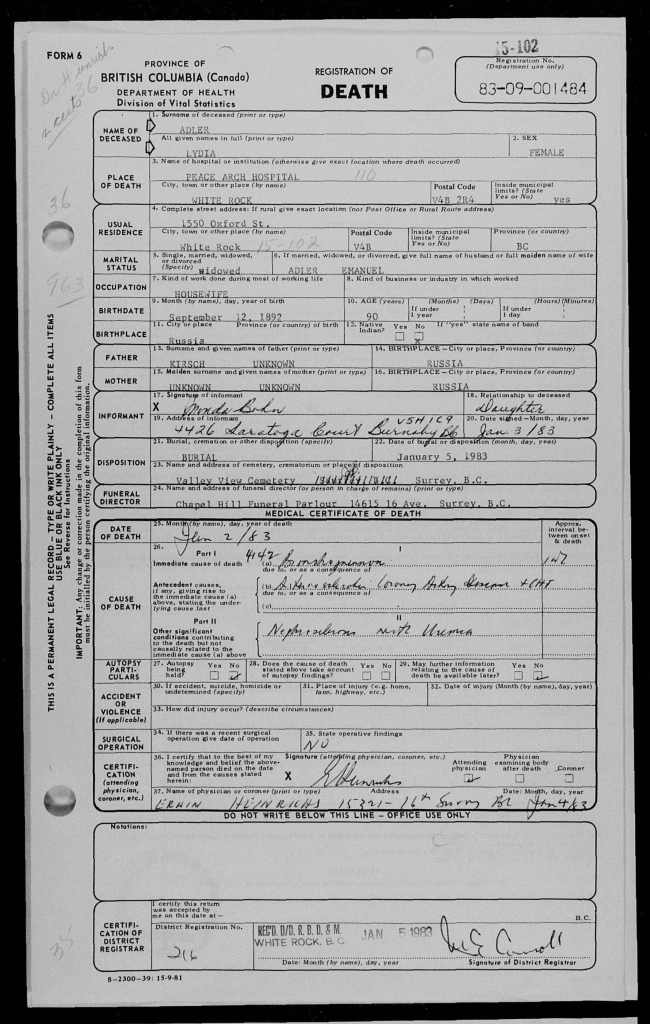
Many homesteaders in the Lipton area abandoned farming and went to live in cities.[9] In the 1949 Canadian “Rural List of Electors,” Emanuel is a farmer and still resides in Lipton.[10] In the 1957 list, Lydia and Emanuel are living in Vancouver, British Columbia, on East 55th Avenue.[11] Emanuel worked as a janitor.[12] In 1965, Emanuel and Lydia lived on Fraser Street in Vancouver (perhaps in the area of East 55th Avenue and Fraser Street).[13] When Emanuel died on April 14, 1976, their address was 1550 Oxford Street in White Rock, British Columbia, which is the Evergreen Community assisted living community today.[14] Emanuel was eighty-eight years old. Lydia died at the Peace Arch Hospital in White Rock at the age of ninety, on June 2, 1983.[15] She left behind a large family, including thirteen grandchildren and eleven great-grandchildren.[16]
“[Lydia Adler registration of death, 1983],” accessed 03 Aug 2022 through Provincial Archives of British Columbia
Descendants of Lydia Kirsch and Emanuel Adler
Lydia Kirsch (b. 20 Aug 1892 in Ludwischin, Lutsk, Volhynia, Russia; d. 03 Jan 1983 in White Rock, British Columbia, Canada) m. (12 Jul 1913 in Winnipeg, Manitoba, Canada) Emmanuel Adler (b. 29 Oct (09 Nov) 1888 in Mjetschislawow, Lutsk, Volhynia, Russia; d. 14 Apr 1976 in White Rock, British Columbia, Canada)
Frederick Emanuel Adler (b. 23 Dec 1916 in Winnipeg, Manitoba, Canada; d. 1918 in Manitoba, Canada)
Paul Emil Adler (b. 26 Jan 1921 in Winnipeg, Manitoba, Canada; d. 14 Dec 1995 in Regina, Saskatchewan, Canada) m. (03 Jul 1947 in Lipton, Saskatchewan, Canada) Martha Lydia Engel (b. 04 Feb 1926 in Lemburg, Saskatchewan, Canada; d. 25 Apr 2000 in Regina, Saskatchewan, Canada)
Hedy (Heddie) Eileen Adler (b. 1923; d. 28 Sep 2016 in Oakville, Ontario, Canada) m. (abt 1949) Robert Alexander (b. 1919; d. 11 Apr 2011 in Oakville, Ontario, Canada)
Bertha Alma Adler (b. 1926 in Lipton, Saskatchewan, Canada; d. 16 Jan 2010 in Lipton, Saskatchewan, Canada) m. (26 Apr 1944 in Lipton, Saskatchewan, Canada) Edwin Siegfried Senft (b. 25 Apr 1921 in Lipton, Saskatchewan, Canada; d. 23 Dec 1998 in Lipton, Saskatchewan, Canada)
Violet Ruth Adler (b. 14 Mar 1928 in Canada; d. 26 May 1937 in Lipton, Saskatchewan, Canada)
Hertha Adler (b. 06 Jul 1930 in Lipton, Saskatchewan, Canada) m. James Manton (b. 25 Dec 1930 in Birmingham, England)
Monda Adler m. Arthur Bohn (b. 28 Mar 1934 in Manola, Alberta, Canada; d. 28 Aug 2008 in Delta, British Columbia, Canada)
Ewald Roy Adler (b. 18 Apr 1935 in Lipton, Saskatchewan, Canada; d. 03 Nov 1997 in Burnaby, British Columbia, Canada) m. Marguerite Reid
[1] 1916 Canada Census of Manitoba, Saskatchewan, and Alberta (1912) and 1921 Census of Prairie Provinces, 1926 (1910)
[2] “Lydia Kirsch” in Manitoba, Marriage Index, 1879-1931, accessed 20 Jul 2021 through Ancestry
[3] 1916 Canada Census of Manitoba, Saskatchewan, and Alberta
[4] “Frederick Emanuel Adler” in Manitoba, Canada, Birth Index, 1866-1912, accessed 20 Jul 2021 through Ancestry
[8] “Violet Adler [Registration: 2982]” in Genealogy Index Searches, accessed 20 Jul 2021 through eHealth Saskatchewan [Note: Place of death is 02-24-14-2]
Click here for the first part of this post, Finding Serafina Kelm. My search for how the Kelm family ended up in Winnipeg led me to explore the family connections that made it possible. I also love a good puzzle.
Photograph of the Kelm family, around 1909 or 1910; scan courtesy of P. Reakes
When Serafina was twenty-two years old, she and her husband, Julius Kelm, and two children left their home in or near Hofmanofka, Novograd-Volynsk, Volhynia, for Winnipeg. What information we know about Serafina is from her arrival in Winnipeg in 1906 and her death four years later. Shortly before her death, Serafina posed for a photograph; she is blue-eyed and serious, wearing a black dress and a hat full of flowers. Posing alongside her are her husband, Julius; her daughter, around six years old, Olga; and her youngest son, William.
Serafina’s daughter, Olga, was born July 21, 1903, in Hofmanofka and baptized August 10 in nearby Neudorf.[1] The parents in this record are Julius Kelm and “Seraphine Albert.” There is a record of a “Serafine Albert” born June 17, 1883, in Maksimilianowka, Novograd-Volynsk, to Georg Albert and Marianna Abram.[2] The year of birth matches that of the aforementioned Serafina Albert. Additionally, Maksimilianowka was around twenty kilometers from Neudorf.
The month after their arrival in 1906, Julius and Serafina were enumerated in the 1906 Census of Manitoba, Saskatchewan, and Alberta. They lived at 677 Ross Street, Winnipeg, with “H. Albert,” thirty years old and having arrived in Canada in 1901.[3] A possible relative of Serafine’s, he may have helped them emigrate. Finding out who “H. Albert” is may flesh out the Kelm family’s immigration story, as well provide more insight into who Serafina was.
According to the Society for German Genealogy in Eastern Europe, Georg Albert and Marianna Abram also had a son, Julius Albert, born in 1862 in Augustopol, Lodzkie, Poland, who immigrated to Canada in 1906.[4] His family is found in the 1911 Census of Canada living on their homestead (31-51-24-W4) in Strathcona, Alberta (now merged with Edmonton).[5] Because family often lived close to one another, a search for any other Albert surname was conducted in the Strathcona area. According to the 1911 Census of Canada, Herman Albert and his family lived next to Julius at 31-51-25-W4, though they would be found in Township 43 in the 1916 Canada Census of Manitoba, Saskatchewan, and Alberta.[6] Additionally, Herman and his wife, Paulina Wilde, were possibly still living in Winnipeg in 1911. Three of their children were born in Winnipeg in 1908, 1910, and 1912.[7] Paulina’s place of birth was “Johannesdorf (Solomiak),” which was just seven kilometers north of Maksimilianowka.[8] Finally, Herman and Paulina also had a daughter named Seraphina, whose preferred name was Sarah. Serafina, an unusual name based on my observations, was a popular name in the family.
Looking at the facts, Herman Albert is likely the H. Albert living with Julius and Seraphina in 1906 and Serafina Albert is the same “Serafine” born in Maksimilianowka. Herman’s wife and three children joined him in Winnipeg in October of 1906, so he could have been erroneously marked as single in the 1906 census.[9] His death record does not reveal his parents’ names, if they were the same as Julius’ and Serafina’s. Herman died of “tertiary syphilis” in 1925.[10]
[1] “[Olga Kelm birth record]” from Volhynia Archives Birth Indexes – 1900-1918, accessed 12 Jun 2021 through Society for German Genealogy in Eastern Europe
[2] “[Serafine birth record]” from Volhynia Archives Birth Indexes – 1900-1918, accessed 12 Jun 2021 through Society for German Genealogy in Eastern Europe
[3] 1906 Census of Manitoba, Saskatchewan, and Alberta, Library and Archives Canada, accessed 13 Jun 2021 through Ancestry
[4] Master Pedigree Database, accessed 18 Jun 2021 through Society for German Genealogy in Eastern Europe
[5] 1911 Census of Canada, Library and Archives Canada, accessed 13 Jun 2021 through FamilySearch
[6] 1916 Canada Census of Manitoba, Saskatchewan, and Alberta, Library and Archives
[7] “[Herman Albert and Wilhelm Albert birth information]” in Manitoba Vital Statistics Agency database index, accessed 13 June 2021; 1916 Canada Census of Manitoba, Saskatchewan, and Alberta, Library and Archives Canada, accessed 13 June 2021 through Ancestry
[8] “Pauline Albert (Wilde)” in King/Burton Family Tree [Ancestry family tree], accessed 18 Jun 2021 through Ancestry
[9] “Panline Albert” in Canada, Arriving Passengers Lists, 1865-1935, Library and Archives Canada, accessed 11 June 2021 through Ancestry
[10] [“Herman Albert Registration of Death, 1961”], Provincial Archives of Alberta. Digital copy emailed 29 Mar 2021
Happy June, everybody! Memorial Day long weekend here in the USA was spent researching and writing my History of Martha project. I realized that this blog has been a useful way for me to organize book sections and get feedback. Everything will eventually make its way into my Kirsch family book, which I hope to finish next year. The following section is tentatively titled “Julia Kirsch: Journey from Ludwischin-Scheppel, Volhynia, to Winnipeg, Canada, 1890-1943” in the book, but will be the Julia Kirsch series entry for 19 Kirsch Children for the purposes of this blog. Because this blog is the rough draft of my project, I welcome any corrections or additions. I am also hoping that someone has a photo of Julia and August Rempel.
I would also like to apologize for the horrendous citations throughout this blog. I keep reformatting them as I go in order to find a style that works for me. I recently decided to add in source repositories or archives, but have to go back and track them all down.
19 Kirsch Children: Julia Kirsch
Julia Kirsch was born Julianna Kirsch on August 25, 1865, in Florentynow, Lodzkie, Poland, the third child and first daughter of Samuel Kirsch and his first wife, Karolina Wurfel.[1] Julia was confirmed in the Lutheran church (Rozyszcze parish, Volhynia) in 1881, though the absence of parents’ names in the record means the connection cannot be verified.[2]
“[Julianna Kirsch birth record, 1865]” from Akta stanu cywilnego Filiału Ewangelicko-Augsburskiego w Dziepółci, accessed 16 Mar 2021 through Geneteka
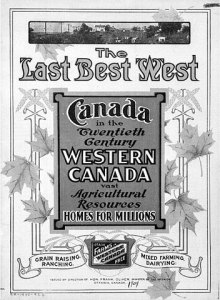
The Kirsch family’s migration to Canada began earlier than Winnipeg’s population boom, which began over a decade later in 1902. Winnipeg grew steadily by 1000-3000 people each year (except for a significant population increase after the completion of the Canadian Pacific Railway in 1881) from 1871 to 1901.[3] The majority of Russian Germans immigrated to Canada after 1900, after the homesteads of the United States were all snatched up.[4] Minister of the Interior Clifford Sifton’s immigration policy of 1896 and the heyday of Canada’s “Last Best West” campaign spurred more immigration, the ideal immigrant, in Sifton’s words, being the “stalwart peasant in a sheep-skin coat, born on the soil, whose forefathers have been farmers for ten generations, with a stout wife and a half-dozen children.”[5]
Example of “Last Best West” campaign poster, 1907; courtesy of Canada. Department of the Interior, Library and Archives Canada
Julia was the first Kirsch family member to immigrate to Canada. She and her husband, August Rempel, married three years with two young children (Adolf and August), sold their belongings and left their community of Ludwischin-Scheppel in early October of 1890, their decision likely driven by religious persecution. While the majority of Russian Germans were Lutheran, the Rempel family, like many other families in their community, was Baptist.
According to Volhynian Baptist historian Donald Miller, Scheppel was a Baptist station in Rozyzscze parish. While Rozyzscze city was home to the largest Baptist church in the parish (established in 1884), there were several (mission) “stations” established, including Scheppel, where people from various communities congregated to worship. Some of these stations became self-supporting churches.[6] Other names for Scheppel are Scheple, Schepek, Schöpel, Schlepe, Szepel, and Schelpe.[7] Baptist activity began in Rozyzscze parish (Rozyzscze city being approximately twenty-two kilometers south of Scheppel) in 1874, when seven new converts were baptized and, shortly after, a chapel was built. In April of 1889, after a period of evangelical growth (despite the Lutheran majority’s opposition, which was sometimes very violent), the church’s pastor was banished from Volhynia and the people were no longer allowed to gather in the chapel. This prompted many families to emigrate in the pursuit of religious freedom.[8] In 1890, there was an exodus of Baptist families from Ludwischin-Scheppel.
“Often the outdoor baptismal services were disrupted, members were accused of preaching a false doctrine, converts were ridiculed, pastors were threatened and church buildings were destroyed.”
According to an 1894 article in The Winnipeg Tribune, the German Baptists “were driven from their homes and from their churches and must seek new homes in this land […] The exodus from Russia began twelve years ago when the persecutions began.”[10] Following the world wars, Baptist church records in Volhynia were destroyed, many churches converted into industrial complexes and used for secular purposes. This is the reason tracing Baptist families in Volhynia during the late nineteenth century is “very difficult if not impossible.”[11]
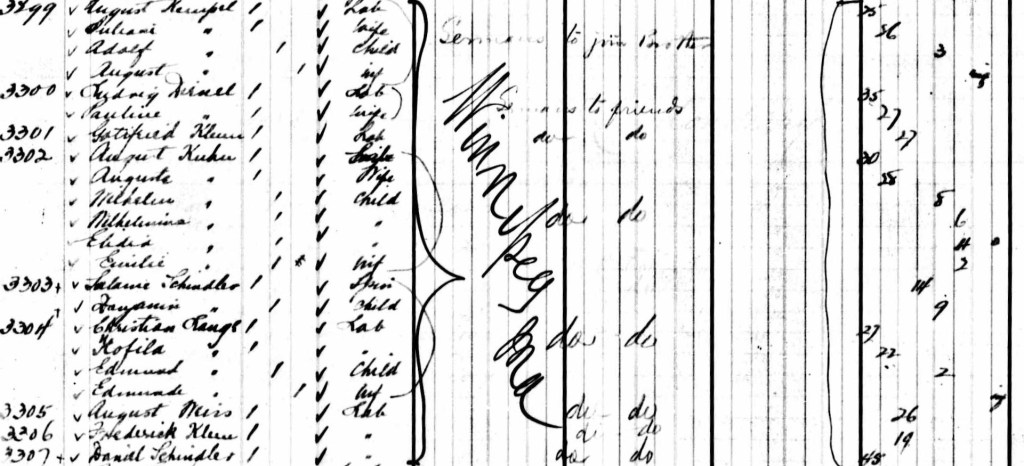
When Julia and August left Volhynia in 1890, they left in a party of twenty-four people from six families, also Baptists from Ludwischin-Scheppel (more information about these families here). The families likely departed together by wagon and then traveled by train to Berlin, Germany, which connected them to major ports.[12] The journey from Volhynia to Hamburg, their port of departure, probably took a week.[13] The party left Hamburg on October 10 on the ship Hansa.[14] Because it was cheaper to travel across the Atlantic using British lines,[15] the families traveled to Hull, England, and then traveled by train to Liverpool. There they boarded the British steamship, the SS Polynesian, which took them to the Port of Quebec after a stop in Londonderry, Ireland.[16] The ship arrived in Canada on October 27.
Rempel family (top-most entry) in SS Polynesian ship manifest, Canada, Arriving Passengers Lists, 1865-1935, Library and Archives Canada, accessed 29 May 2021 through Ancestry
According to the SS Polynesian ship manifest, the passengers were going “to friends.”[17] The Rempel family had traveled “to join brother,” though no record of a Rempel relative in Canada has been found.[18] August had at least one living brother, Ludwik Rempel, born in 1871, but his whereabouts in 1890 is unknown.[19] When August’s mother, Rose Rempel, died in Springfield, Manitoba, two printings of her obituary in The Winnipeg Tribune have conflicting information; the shorter June obituary indicates she was “survived by two sons” while the longer June 7 obituary mentions only “one son, Augustus of Winnipeg.”[20] After arriving in Quebec, the families boarded the train to Winnipeg. The trip took three days, meaning they would have arrived October 30.[21] In the 1891 Census of Canada, the Rempel family lived in Ward Five, otherwise known as Winnipeg’s North End and “Foreign Quarter”–just north of the Canadian Pacific Railway yards.[22] The family lived with two other German Baptist families: Frederick and Caroline Maahs, and John and Rosaline Bicker (and two-year-old son, Frederick).[23] The three families, eight people in all, lived in a six-bedroom home. The family next door, also predominantly Baptist, were eleven people in two bedrooms, including two people from the party that left Ludwischin-Scheppel: Friedrich (Frederick) and Gotfried (Godfrey) Klem.[24] The North End was notorious for its deplorable living conditions, disease, and overcrowding.[25]
The Rempel family experienced tragedy soon after their arrival in Winnipeg. While their oldest child, Adolf, was with them when they arrived in Quebec on October 27, 1890, he was not with them when the family was enumerated in the 1901 Census of Canada on April 23, 1891.[26] While a record of the death of Adolf Rempel has yet to be found, there is a record of August Rempel, age three, who died March 11, 1891, in Winnipeg (August’s full name was Gustave August Rempel, so perhaps the eldest was August Adolf Rempel).[27] August’s and Julia’s first daughter, Helen “Lena” Margaret Rempel, was born Christmas Eve 1891.[28] Their second daughter, Ada Rempel, was born December 11, 1893.[29] Ada does not appear on the 1901 Census of Canada and no death record has been found, but the headstone for Edith Rempel in Brookside Cemetery contains the following: “Edith, died May 11, 1900, aged 6 years and 5 months, daughter of A. and J. Rempel.”[30]
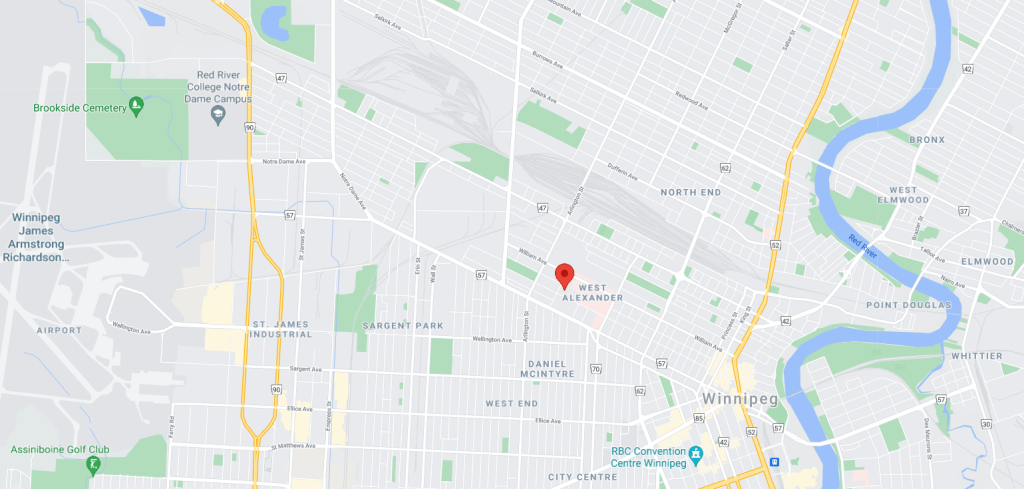
Map of Winnipeg showing location of Bannatyne Avenue, where the Rempel family lived. The gray lines represent the Canadian Pacific Railway yards, the North End indicated above it; courtesy of Google Maps (captured 31 May 2021)
Advertisement in The Winnipeg Tribune, 17 Sep 1938; courtesy of Newspapers.com
In 1901, the Rempel family were now six and still lived in the North End.[31] Julia’s brother, Christian Kirsch, who immigrated in 1893, and his family lived two houses away.[32] Both August Rempel and Christian worked for the Bridge Department of the Canadian Pacific Railway.[33] In 1906, the Rempel family lived at 509 Alexander Avenue.[34] By 1908, the Rempels lived on Bannatyne Avenue (the address is 814 Bannatyne Avenue in the 1911, 1916, and 1921 Censuses of Canada)[35] and worked as a sewage and watermain contractor, hiring workers to dig sewer lines for the City of Winnipeg. According to family history, the Rempel house was two or three floors and extra rooms were rented out to boarders, most working at the nearby Winnipeg General Hospital (now the Health Sciences Centre). Some of these boarders worked for August’s business, including Julius Kelm, who lived in the basement in the early months of 1908. A 1928 rent advertisement for 814 Bannatyne in the Winnipeg Tribune describes the house as follows: “10-room house, hardwood downstairs, gas water heater, newly dec. throughout, first-class condition, 2 garages.”[36] The location is now a parking garage. Between 1922[37] and 1928, the Rempel family moved to 808 Bannatyne Avenue (August’s and Julius’ son, Frederick, and his wife, Mary, lived at 814 Bannatyne before 1928; the house was placed for rent after Mary’s death in 1927).[38]
August and Julia Rempel had nine children: Adolf, August, Helen, Edith, Frederick, Hannah, William, Violet, and Walter. They lived in Winnipeg the rest of their lives and were active members of the McDermot Avenue Baptist Church. Julia died in her home on December 8, 1932, at the age of sixty-seven.[39]
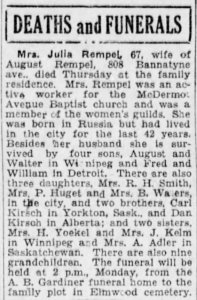
Obituary for Julia Rempel in The Winnipeg Tribune, 1937; courtesy of Newspapers.com
Mrs. Julia Rempel, 67, wife of August Rempel, of 808 Bannatyne Ave., died Thursday at the family residence. Mrs. Rempel was an active worker for McDermot Avenue Baptist Church and was a member of the women’s guilds. She was born in Russia but had lived in the city for the last 42 years. Besides her husband she is survived by four sons, August and Walter in Winnipeg and Fred and William in Detroit. There are also three daughters, Mrs. R. H. Smith, Mrs. P. Huget and Mrs. B. Waters in the city, and two brothers, Carl Kirsch in Yorkton, Sask., and Dan Kirsch in Alberta; and two sisters, Mrs. H. Yoekel and Mrs. J. Kelm in Winnipeg and Mrs. A Adler in Saskatchewan. There are also nine grandchildren. The funeral will be held at 2 pm, Monday, from A. B. Gardiner funeral home to the family plot in Elmwood cemetery.[40]
August died February 21, 1943, three years after retiring.[41] According to his obituary in the German Baptist newspaper, Der Sendbote, he became very ill and died after two weeks at the Winnipeg General Hospital: “He bore his suffering with the help of God patiently and attended church and Bible study regularly. About fourteen days before his parting his condition suddenly turned and he had to go to the hospital. There, no doctor could help him and the Lord over life and death decreed otherwise and took him after a few days of heavy suffering into eternity. Even though his passing left a gap on our lives, we rejoice in his well-deserved rest.”[42]
Descendants of August and Julia Rempel
Julianna “Julia” Kirsch (b. 25 Aug 1865 in Florentynow, Lodzkie, Poland; d. 08 Dec 1932 in Winnipeg, Manitoba, Canada) m. August Rempel (b. 18 Jul 1866 in Ignacow, Lodzkie, Poland; d. 21 Feb 1943 in Winnipeg, Manitoba, Canada)
Adolf Rempel (b. 1887 in Russia; d. 11 Mar 1901 in Winnipeg, Manitoba, Canada) – to be confirmed
Gustave August Rempel (b. 13 Aug 1889 in Russia; d. 20 Mar 1976 in Vancouver, British Columbia, Canada) m. Joanna Ida Marks (b. 15 Jul 1891 in Plum Coulee, Manitoba, Canada; d. 27 Aug 1957 in Vancouver, British Columbia, Canada)
Helen Margaret Rempel (b. 24 Dec 1891 in Winnipeg, Manitoba, Canada) m. Roman August Smith (b. May 1884 in Russia; d. 1960 in Manitoba, Canada)
Edith (Ada) Rempel (b. 11 Dec 1893 in Winnipeg, Manitoba, Canada; d. 11 May 1900 in Winnipeg, Manitoba, Canada) – to be confirmed
Frederick Rempel (b. 22 Mar 1896 in Winnipeg, Manitoba, Canada; d. 30 Oct 1877 in Buffalo, New York, USA) m. Mary Susan Jackson (b. 15 Jul 1896 in Ontario, Canada; d. 14 Dec 1927 in Winnipeg, Manitoba, Canada) m. Alice Whitcomb (b. 18 Mar 1906 in New York, USA; d. Mar 1971 in Buffalo, New York, USA)
Hannah Emma Rempel (b. 28 Jan 1899 in Winnipeg, Manitoba, Canada) m. Peter Huget (b. Dec 1894 in Plum Coulee, Manitoba, Canada; d. 16 Aug 1945 in Winnipeg, Manitoba, Canada)
William Albert Rempel (b. 26 Jul 1901 in Winnipeg, Manitoba, Canada; d. 08 Sep 1978 in Palm Beach, Florida, USA) m. Mary Semmler (b. 15 Jul 1900 in Poland; d. 05 Apr 1993 in Palm Beach, Florida, USA)
Violet Elsie Rempel (b. 14 Oct 1903 in Winnipeg, Manitoba, Canada) m. Bert William Watters (b. 24 May 1894 in Westbourne, Manitoba, Canada)
Walter Alexander Rempel (b. 14 Oct 1903 in Winnipeg, Manitoba, Canada; d. 20 Aug 1983 in Burnaby, British Columbia, Canada) m. Edna May Donaghy (b. 17 Jul 1905 in Birkenhead, Cheshire, England; d. 18 Jul 1987 in Port Moody, British Columbia, Canada)
[1] “[Julianna Kirsch birth record, 1860]” from Akta stanu cywilnego Filiału Ewangelicko-Augsburskiego w Dziepółci, accessed 16 Mar 2021 through Geneteka
[2] “[Juliane Kirsch confirmation record, 1881]” from VKP Birth & Confirmation Records, accessed 16 Mar 2021 through Society for German Genealogy in Eastern Europe
[3] Alan F. J. Artibise, Winnipeg: A Social History of Urban Growth, 1874-1914, Montreal: McGill-Queen’s University Press, 1975, p130
[6] Donald Miller, In the Midst of Wolves: A History of German Baptists in Volhynia, Russia, 1863-1943, Portland, OR: Multnomah Printing, 2000, p229-242; p291
[19] “[Ludwik Rempel birth record, 1871]” from “Akta stanu cywilnego Parafii Ewangelicko-Reformowanej w Zelowie (Evangelical Reformed Parish in Zelów Records),” Archiwum Państwowe w Łodzi (Lodz State Archives), accessed 31 May 2021 through Geneteka
[20] The Winnipeg Tribune, 06 Jun 1935 and 07 Jun 1935, accessed 27 May 2021 through Newspapers.com
[21] Victor Gess, Portrait of a Homesteader: An Ancestral Journey Through Poland, Volhynia and Canada, Lafayette, CA: Missouri River Press, 2017, p159
[34] 1906 Canada Census of Manitoba, Saskatchewan, and Alberta, Library and Archives Canada, accessed 31 May 2021 through Ancestry
[35] 1911 Census of Canada, Library and Archives Canada, accessed 31 May 2021 through FamilySearch [Note: surname spelled Rimpell]; 1916 Census of Canada, Library and Archives Canada, accessed 31 May 2021 through Ancestry; 1921 Census of Canada, Library and Archives Canada, accessed 31 May 2021 through Ancestry
[36] The Winnipeg Tribune, 25 Aug 1928, accessed 31 May 2021 through Newspapers.com
[37] “Augustus Rempel” in Henderson’s Winnipeg Directory, 1922, accessed 31 May 2021 through Ancestry [Note: August is working as a contractor; Violet Rempel (dressmaker) and Walter Rempel (fire department clerk) also live at home in 1922]
[38] “[Obituary for Mary Ann Rempel]” from The Winnipeg Tribune, 14 Dec 1927, accessed 31 May 2021 through Newspapers.com
[39] “[Obituary for Julia Rempel]” from The Winnipeg Tribune, 08 Dec 1932, accessed 31 May 2021 through Newspapers.com
[40] “[Obituary for Julia Rempel]” from The Winnipeg Tribune, 09 Dec 1932, accessed 31 May 2021 through Newspapers.com
[41] “[Obituary for August Rempel]” from The Winnipeg Tribune, 22 Feb 1943, accessed 31 May 2021 through Newspapers.com
[42] “[Obituary for August Rempel]” from Der Sendbote, 17 Mar 1943, “United States, Obituaries, American Historical Society of Germans from Russia, 1899-2012” [collection by American Historical Society of Germans from Russia], accessed 30 May 2021 through FamilySearch; translated by Margot Henriksen
Welcome to the next installment of 19 Kirsch Children, a blog series about the Kirsch family and siblings of my great-grandmother, Martha Kirsch. You can access an overview of the entire family right here. I lived in West Kelowna for several years and while job hunting with a friend across the bridge in Kelowna, decided to walk across the street from his home to the cemetery where Karl is buried. I had just learned about this Kelowna connection that summer of 2016.
19 Kirsch Children: Karl Kirsch
Karl Kirsch was born to Samuel Kirsch and Karolina Wurfel on March 13, 1877, in Ludwischin, Lutsk, Volhynia (later records have Karl’s date of birth as March 27, but this may be because of the change in calendar; Russia added thirteen days when it officially switched from the Julius to Gregorian calendars on February 1 (Julian) and 14 (Gregorian), 1918).[1] Karl married Olga Dymmel, also born in Ludwischin, in 1901, and they had five children, all born in Wladislowka, Volhynia: Amanda, Hulda (or Huldena), Annie, Daniel, and a child who died young.[2] According to the Baptist newspaper Der Sendbote, Karl, whose family was Lutheran, became a Baptist and was baptized in Volhynia.[3]
[“Carl Kirsch birth record, 1877”] from VKP Birth and Confirmation Records, accessed 19 Apr 2021 through Society for German Genealogy in Eastern Europe
Karl left his wife and children for Canada in 1913. The journey in steerage, from Hamburg, Germany, to Halifax, Nova Scotia, Canada, took just over two weeks; the ship, La Plata, left May 27 and arrived June 12.[4] At the time of his departure, Karl lived in Wladislowka.[5] There were two colonies near Lutsk named Wladislowka, the closest colony to Karl’s birthplace being “Wladislowka” and not “Wladislowka II,” which was further east.[6] According to interviews with Julius and Martha (see Stories from the Past: Martha Kirsch (Part 3)), Karl lived in the home of his oldest sister, Julia Rempel, at 808 Bannatyne Street in Winnipeg, Manitoba, and may have worked for the Canadian Pacific Railway. Karl lived in Winnipeg for a year before moving to the predominantly German Baptist community of Ebenezer, Saskatchewan (see 19 Kirsch Children: Daniel Kirsch for more information about Ebenezer). His brother Daniel’s homestead was also near Ebenezer.
The outbreak of the First World War prevented Karl from sending for his family for eight years. His family likely found themselves deported to Siberia alongside other Volhynian Germans for the duration of the war, but there is no information about their whereabouts during this time. By 1916, Karl was living in Mackenzie (district), Saskatchewan, working on the farm of the Dutz family (William and Wilhelmina Dutz).[7] In 1921, Karl was working as a farm labourer for the Keels family, also in Mackenzie.
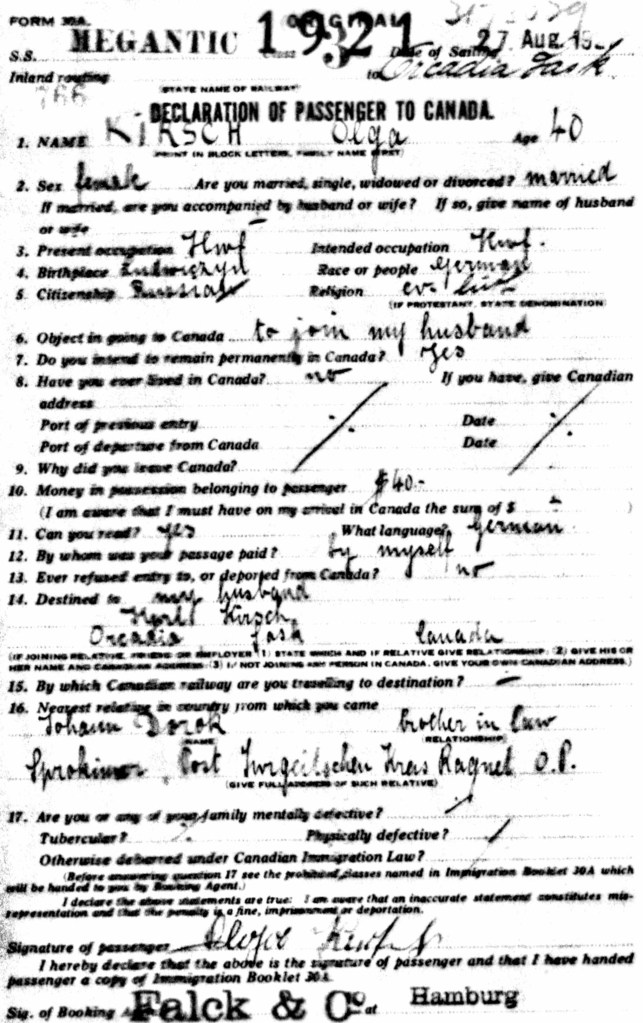
“Olga Kirsch” in Canada, Ocean Arrivals (Form 30A), 1919-1924, accessed 21 Apr 2021 through Ancestry
Following the First World War, Olga and her children found themselves in “Sprokinen.”[8] Sprokinen (Sprukkinen) may refer to a now defunct community in Kaliningrad Oblast (administrative region), Russia, near the Russia-Lithuania border.[9] Olga and her children left Europe from Hamburg, Germany, on the Megantic, their destination Orcadia, Saskatchewan (near Ebenezer). The ship arrived in Canada on August 27, 1921. The family had forty dollars when they arrived. According to the Hamburg passenger list, Hulda was supposed to accompany her family, but her name is crossed out.[10] Hulda was the last member to join the family in Canada, traveling to Saskatchewan alone the following year to find work as a maid.[11] Both Amanda and Hulda were married in 1922, with Amanda accompanying her husband, Emanuel Behr, back to his home in Moundridge, Kansas, USA. Hulda and her husband, William Aichele, started a family in Otthon, Saskatchewan.
Olga died August 9, 1938, in Springside, Saskatchewan. Karl moved to Kelowna, British Columbia, in 1949. His son, Daniel, had been living there for several years (Daniel married his wife, Frieda Wentz, in Kelowna in 1940).[12] Karl’s daughter, Amanda, moved to Kelowna at the same time as her father, settling in the Benvoulin area with her husband, Michael Pansegrau. Karl died at the Kelowna General Hospital on March 13, 1950.
Article in The Province (December 11, 1945) about the fire that burned down the Pansegrau home in Kelowna. Evelyn and Allen Pansegrau were the children of Annie Kirsch and Michael Pansegrau; accessed 21 Apr 2021 through Newspapers.com
“[Karl Kirsch registration of death, 1950],” accessed 21 Apr 2021 through Provincial Archives of British Columbia
Karl Kirsch (b. 27 Mar 1877 in Ludwischin, Lutsk, Volhynia, Russia; d. 12 Mar 1950 in Kelowna, British Columbia, Canada) m. Olga Dymmel (b. 25 Dec 1878 in Ludwischin, Lutsk, Volhynia, Russia; d. 09 Aug 1938 in Springside, Saskatchewan, Canada)
Amanda Kirsch(b. 26 Nov 1901 in Wladislowka, Lutsk, Volhynia, Russia; d. 03 Jan 1976 in Moundridge, Kansas, USA) m. Emanuel Behr (b. 27 Mar 1895 in Russia; d. 20 Jan 1984 in Moundtridge, Kansas, USA)
Hulda Kirsch (b. 21 Mar 1905 in Wladislowka, Lutsk, Volhynia, Russia; d. 26 May 1961 in Saltcoats, Saskatchewan, Canada) m. William Aichele (b. 13 May 1896 in Russia; d. 25 Apr 1976 in Yorkton, Saskatchewan, Canada)
Annie Kirsch (b. 12 Jan1909 in Wladislowka, Lutsk, Volhynia, Russia; d. 04 Feb 1953 in Kelowna, British Columbia, Canada) m. Michael Pansegrau (b. 04 May 1910 in Poland; d. 01 Oct 1982 in Kelowna, British Columbia, Canada)
Daniel Kirsch (b. 25 Dec 1911 in Wladislowka, Luck, Volhynia, Russia; d. 22 Jun 1983 in Kelowna, British Columbia, Canada) m. Frieda Weintz (b. 02 Dec 1921 in Tariverde, Constanta, Romania; d. 12 Oct 2005 in Kelowna, British Columbia, Canada)
Unknown Kirsch (d. bef 1913 in Volhynia, Russia)
[1] [“Carl Kirsch birth record, 1877”] from VKP Birth and Confirmation Records, accessed 19 Apr 2021 through Society for German Genealogy in Eastern Europe
[2] [“Karl Kirsch obituary from Der Sendbote newspaper, 1950”] from United States, Obituaries, American Historical Society of Germans from Russia, 1899-2012, accessed 19 Apr 2021 through FamilySearch [Note: Der Sendbote was a newspaper issued by the German Baptist Publication Society from 1874 to 1971, with contributions by the North American Baptist Conference – Library of Congress]
[3] [“Karl Kirsch obituary from Der Sendbote newspaper, 1950”] from United States, Obituaries, American Historical Society of Germans from Russia, 1899-2012, accessed 19 Apr 2021 through FamilySearch
[4] “Karl Kirsch” in Hamburg Passenger Lists, 1850-1934, accessed 19 Apr 2021 through Ancestry
[5] “Karl Kirsch” in Hamburg Passenger Lists, 1850-1934, accessed 19 Apr 2021 through Ancestry
[6] “Wladislowka II” from “Google Maps of Ancestral German Colonies (1700-1939),” accessed 15 Nov 2020 through Germans from Russia Settlement Locations
[7] 1916 Census of Manitoba, Saskatchewan, Albert, accessed 15 Nov 2020 through Ancestry
[8] “Olga Kirsch” in Hamburg Passenger Lists, 1850-1934, accessed 15 Nov 2020 through Ancestry
[10] “Olga Kirsch” in Hamburg Passenger Lists, 1850-1934, accessed 15 Nov 2020 through Ancestry
[11] Canada, Ocean Arrivals (Form 30A), 1919-1924 Hulda Kirsch Declaration of Passenger to Canada accessed through Ancestry 15 Nov 2020
[12] “[Daniel Kirsch and Frieda Weintz certificate of registration of marriage, 1940],” accessed 21 Apr 2021 through Provincial Archives of British Columbia












 Kelm History Blog