Emails from distant cousins are very exciting–and they seem to come when I declare I am taking a break to bolster the research and polish the writing I already have. I am not complaining, though. I want to thank Janet Hill for taking the time to send documents and photographs to do with her great-grandfather (my great-grandmother’s brother), Christian Kirsch, who was tragically killed at his work at the Winnipeg CPR railway yards in 1924. Her emails have encouraged me to come back to my History of Martha book project. My son was born five months ago and I have missed sneaking away to write.
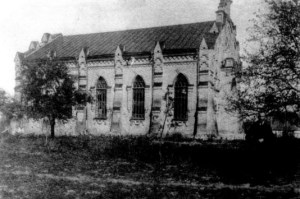
Rozyszcze Baptist church, date unknown. Courtesy of In the Midst of Wolves. Here is a news article about the state of it in 2017, including a recent photo.
Among the documents emailed to me was a clipping of an obituary in German, possibly from the German Baptist newspaper, Der Sendbote. I was surprised to find small details that give insight about the Kirsch family’s conversion from Lutherans to Baptists in Volhynia. According to the obituary, Christian was baptized in 1882, at the age of twenty-two, by Brother Friedrich Albrecht and was a member of the Rozyszcze (also Rozhyshche) congregation. Donald Miller, in his “Volhynian Baptist Churches and Pastors, 1864-1940,” lists Johann Albrecht as being the first pastor for Rozyszcze from 1882 (he was not yet the pastor when Christian was baptized) to his expulsion from Volhynia in 1889. I am not certain Friedrich Albrecht and Johann Albrecht are the same man, but perhaps his name was Johann Friedrich or the name was remembered incorrectly. In any case, Johann Albrecht was the pastor in Rozyszcze at the time of Christian’s baptism. His expulsion marked a turning point for many Baptist families in the area, including Christian’s sister, Julia Rempel, whose family immigrated to Winnipeg first, in 1890.
“With the expulsion of [Pastor Johann Albrecht], the [Rozyszcze] church also lost the right to gather for worship in its prayer chapel. When the church was locked, a second chapel was built in another village, but the authorities again denied its use of the building. The desire for religious freedom in part prompted some of the colonists to immigrate to the United States, Canada, and Brazil.” – In the Midst of Wolves by Donald Miller[1]
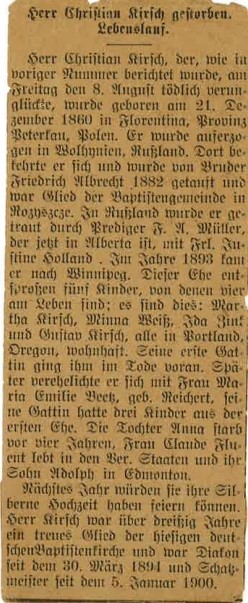
Courtesy of Janet Hill. Newspaper source unknown.
Obituary – Mr. Christian Kirsch died
Mr. Christian Kirsch, as previously reported, died in an accident on Friday, August 8. He was born December 21, 1860, in Florentynow, Poland. He grew up in Volhynia, Russia. He was baptized by Brother Friedrich Albrecht in 1882 and was a member of the Baptist congregation in Rozyszcze. In Russia, he was married by Pastor F. A. Mueller [Friedrich A. Mueller[2]], who lives in Alberta, to Justina Holland. In 1893, they moved to Winnipeg. Their children are Martha Kirsch, Mina [Minnie] Weiss, Ida Zink, and Gustav Kirsch, all living in Portland, Oregon. His first wife died before him. He married Mrs. Emilie Beetz (born Reichert), who had three children with her first husband. Her daughter, Anna, died four years ago. Mrs. Claude Fluent [Julia] lives in the United States and John Adolph lives in Edmonton.
Christian was a faithful member of the local German Baptist church for over thirty years. He was a deacon from March 30, 1894, and church treasurer from January 5, 1900.
The deceased leaves behind his grieving wife, four children, two stepchildren, eleven grandchildren, and four step-grandchildren.
Other family members include Mrs. Julia Rempel, Mrs. Martha Kelm in Winnipeg, two brothers Daniel and Karl Kirsch in Ebenezer, Saskatchewan, and two half-sisters in Poland.
Courtesy of Janet Hill. Newspaper source unknown.
At the funeral service held on Wednesday, August 13, at the German Baptist Church [McDermot Avenue Baptist Church], at which Pastor J. L. Lehpoldt [John Leypoldt[3]] officiated, many relatives were present in addition to his grieving wife and her two children, Gustav and Martha Kirsch from Portland, his brother Daniel from Ebenezer, and his stepson [John] Adolph Beetz and his wife from Edmonton.
Pastor Lehpoldt spoke of Christian: “He was a burning, shining light.” He described the faithful man as quiet, earnest, dutiful, and pious. He bore his name Christian with full right, for he was truly a Christian.
The funeral was very well attended. Many of Christian’s colleagues were present, and Pastor Lehpoldt addressed them in English.
Below are links to previous blog posts about Christian Kirsch, as well as posts that discuss Baptists in Volhynia and the migration to North America. For more detailed research about Baptists in Volhynia, I recommend In the Midst of Wolves (website as well as book, both by Donald Miller).
I hope you are all having a wonderful summer. I am eager for fall and writing cozily in the room I have set up in my new home for reading and genealogy projects (writing my book and scanning photos!). I salvaged all the different iterations of this entry that I started and stopped writing in the last year. This is a very straightforward and condensed history of Germans in Winnipeg, as well as a short history of the McDermot Avenue Baptist Church, which was an important location in Kirsch (and Kelm) family history. This section should be read in conjunction with this entry about Julia Kirsch, my great-grandmother Martha’s oldest sister who migrated to Winnipeg during a period of Baptist persecution in Volhynia and whose home became a launching pad for many of her siblings who would also immigrate within the next twenty-two years. You can find their stories here.
By the time August and Julia Rempel arrived in Winnipeg in 1890, the population of the city was approximately 23,000.[1] They arrived at a time of rapid growth; Canada was actively recruiting immigrants, namely those from western and northern Europe. In the autumn of 1881, The Great Prairie Province of Manitoba and the Northwest Territories was issued in England to attract potential settlers and, by 1884, additional pamphlets and maps were published in other languages and distributed.[2] The population of Winnipeg’s North End, where the Rempel family lived, was 7,819 in 1890; by 1906, it had more than quintupled to 43,527.[3]
Many of these newcomers were of German descent. These Germans were from many places other than Germany, including Eastern Canada, United States, Romania, and Austria-Hungary. Germans from Russia (Volhynia, Black Sea, and Volga), however, represented the largest percentage at 44 percent.[4] According to the 1891 Census of Canada, there were 399 Germans living in Winnipeg.[5] The total number, however, was much greater as the census only recorded place of birth and not ethnicity. Because August and Julia Rempel were both born in Poland, for example, they are recorded in the 1891 Census as being from “Russia Poland.”[6] The 1901 Census of Canada did not distinguish between Germans born in Germany and Germans from elsewhere and recorded 2,285.[7]
In 1885, the Baptist church became concerned with evangelizing the swelling German population in Winnipeg and appealed to the Baptist Conference of the USA (North American Baptist Conference) for help. The following year, the conference enlisted thirty-six-year-old Reverend Friedrich August Petereit (who had been stationed in Minneapolis, Minnesota), the first German pastor of any denomination to administer in Winnipeg.[8] Reverend Petereit preached his first Winnipeg sermon in the city’s old immigration hall, in the mid-February cold: “Last evening[, Reverend Petereit] conducted services again at the immigration sheds where there was also a good attendance. This evening and tomorrow evening the [Reverend] will preach in the Baptist Church, where all Germans will be cordially welcomed.” [9] By April, Reverend Petereit had begun preaching a series of sermons “in the interest of the Germans in the city,” his efforts extending to Dakota Territory where Germans there also relished “this opportunity of hearing the Gospel proclaimed in their own tongue.”[10]
On December 31, 1889, a modest congregation of seventy people proclaimed themselves Erste Deutsche Baptistengemeinde, or The First German Baptist Church: “The founding meeting on the last day of the year closed with singing and prayer and a love feast lasting until the first hours of the new year.”[11] The first church was built on the corner of Alexander Avenue and Fountain Street, not far from the immigration sheds by the Canadian Pacific Railway yards preached in just three years before. This new church was operational by January of 1891, a few months after the Rempels’ arrival. The Rempel family and the twenty-four others also from Ludwischin-Scheppel were among the first wave of German Baptists from Volhynia that settled in Western Canada from 1890 until 1900.[12]
The congregation grew and a new church was built a block away, on the corner of Pacific Avenue and Ellen Street, in 1901.[13] By the time Martha Kirsch arrived in Winnipeg to join her sister Julia in September 1908, the congregation, which now numbered approximately 200 members, had constructed an even larger church on McDermot Avenue and Tecumseh Street,[14] around the corner from where the Rempel family lived at 814 Bannatyne Avenue. The new church was dedicated on February 9, 1908, and was renamed the McDermot Avenue Baptist Church.[15]
Martha married Julius Kelm at the McDermot Avenue Baptist Church on April 14, 1910.
[1] Alan F.J. Artibise, Winnipeg: A Social History of Urban Growth, 1874-1914, (Montreal: McGill-Queen’s University Press, 1975), p139


 Kelm History Blog