Return to Winnipeg, 1921-1965

Happy New Year. Thank you to everybody who took the time to leave a comment or connected with me through email last year. My sincerest apologies if I have forgotten to respond. I blame the two small children in my house for my forgetfulness. If it was a inquiry about whether your Kelm family is related to mine, I likely set the email aside to investigate and then did not have the time to actually do that. You are welcome to remind me.

Return to Winnipeg

The story of how my great-grandparents, Julius (John) and Martha Kelm moved from Winnipeg to their homestead near Camper can be found here: Homesteading Near Camper, Manitoba, 1911-1921. This blog entry speculates about their return to Winnipeg after a decade homesteading on the prairie. I do not know their personal account except that they “had the worse land, unsuitable for farming” (see Stories From the Past). Their story follows the trajectory of many other homesteaders around Camper, so I thought I would explore other accounts.

For this blog entry, I found the University of Manitoba Library’s Digital Collections (especially their Manitoba Local Histories collection) very helpful. Taming a Wilderness: A History of Ashern and District contained a wealth of information and I enjoyed reading the accounts of those who homesteaded near Camper. I had a free trial of Newspapers.com and searched Winnipeg newspapers (you can access The Winnipeg Tribune for free through U of M) for significant events around the time my great-grandparents left their homestead and returned to Winnipeg. Once I found a story to run with, I checked it against local history books. If you click into a digitized book, you can search for keywords (see below).
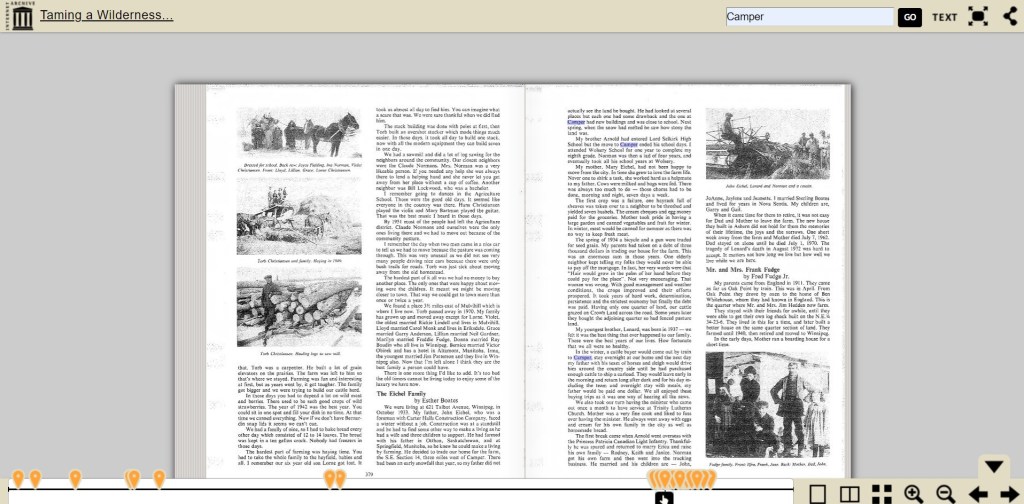
Searching digitized book for instances of “Camper”

Julius and Martha returned to Winnipeg between 1921, when the 1921 Census of Canada recorded them living near Camper, to 1924, when the obituary for Martha’s brother, Christian Kirsch, references her living in Winnipeg.[1] Between 1920 and 1923, bad harvests and falling wheat prices caused economic hardship for many Manitoba farmers and there was an exodus.[2] According to a Maclean’s article published February 1, 1922, “The high cost of producing and marketing the crop, with the heavy drop in prices, […] was responsible for the depression not only felt in Western Canada but reflected in every trade and industry in the Dominion.”[3]

Homesteaders often faced the devastation of fire, but, according to Borghil Olson, whose family homesteaded near Camper, one particular fire that “raged for weeks” caused many to grow restless and leave.[4] In August of 1920, a massive brush fire engulfed the Interlake region. Although the fire caused the most damage around where it originated near Mulville, about fourteen kilometers south of Camper, it had burned north through Camper and Ashern, driven by the season’s lack of rain. Newspapers described the fire’s arrival in Camper: “At Camper a stable and boarding house had been burnt down. The post office caught fire three times but was saved.”[5] In nearby Ashern, “chickens and calves had been roasted alive in the farmyards, and practically all crops destroyed.”[6]

“In 1920 the area was pretty well wiped out by bush fires, which raged for weeks. It was a very dry year, farmers lost most if not all the hay they had for winter as well as the spruce trees that could have been used for lumber. A terrifying experience. I recall we took all the children to Martin Johnson’s place where we figured they were safe from the fire. Mrs. Ben Kristianson and Mrs. Stein looked after the children, did the cooking, etc., while Mrs. Martin and I were out helping the men folk to save our homes and grain fields. Ben Kristianson’s home was a mile away from ours, and he made an agreement with the rest of the men, that if the fire did reach the spruce bluff near his home he would fire a rifle, and this would be a signal for the others to come to help fight fire. This particular day we were having lunch when a gun shot was heard, one of the women said “Ben must have shot a deer.” The men knew better, one by one they took off, to find Ben throwing water from a barrel alongside his house, onto the roof to put out the sparks flying from the spruce bluff close by, this way they did manage to save the home.”[7] – Borghild Olson, from Taming a Wilderness

In the 1926 Census of Manitoba, Saskatchewan and Alberta, the Kelm family except for the oldest son, William, were enumerated at 557 Armetta Avenue in the municipality of West Kildonan. In December of 1929, the “two blocks [of Armetta Avenue] west of McGregor Street, which included the Kelm home, prepared a petition to join the city of Winnipeg in order to obtain sewer service.[8] Armetta Street would later be renamed Matheson Avenue.[9] Julius and Martha would live at 557 Matheson Avenue for the rest of their lives.

Julius died February 27, 1959, at the Concordia Hospital, and is buried in Glen Eden Memorial Gardens in West Saint Paul, north of Winnipeg.[10] He was eighty years old. Martha became a member of the Mountain and Andrews Seventh-Day Adventist Church. She died at the St Boniface Hospital on July 20, 1965, at the age of eighty-four.[11] She is buried with her husband.

Courtesy of Find a Grave; photographed by Holly, 10 Oct 2021

[1] “Christian Kirsch obituary,” 1924, newspaper source unknown, emailed 04 Oct 2024 by J. Hill

[2] Gerhard P. Bassler, The German Canadians, 1750-1937: Immigration, Settlement and Culture (St. John’s, NL: Jesperson Press, 1986), p99

[3] Jenkins, Charles Christopher, “The West Won’t Stay Down!,” 01 Feb 1922, from Maclean’s [magazine], accessed 21 Dec 2021 through https://archive.macleans.ca/article/1922/2/1/the-west-wont-stay-down [note: URL does not seem to be working any longer; access only through paywall (10 Jan 2024)]

[4] Borghild Olson, “Homestead Days,” from Taming a Wilderness: A History of Ashern and District Canadians (Ashern, MB: Ashern Historical Society, 1976), p84. Retrieved 09 Jan 2024 through University of Manitoba Digital Collections, http://hdl.handle.net/10719/2276635

[5] Free Press Prairie Farmer, 25 Jul 1920, accessed 22 Oct 24 through Newspapers.com

[6] Ibid.

[7] Olson, p84

[8] Winnipeg Tribune, 17 Dec 1929, accessed 22 Oct 2024 through Newspapers.com

[9] Manitoba Historical Society, “History in Winnipeg Streets,” 29 Sep 2024 [last revised], from Manitoba Historical Society Archives, accessed 10 Jan 2025 through http://www.mhs.mb.ca/docs/winnipegstreets/index.shtml#m

[10] “KELM,” Winnipeg Evening Tribune, 28 Feb 1959, accessed 18 Apr 2019 through University of Manitoba Digital Collections, http://hdl.handle.net/10719/1934469

[11] “MARTHA KELM,” Winnipeg Evening Tribune, 21 Jul 1965. Retrieved 18 Apr 2019 from University of Manitoba Digital Collections, http://hdl.handle.net/10719/2042634/
Homesteading Near Camper, Manitoba, 1911-1921

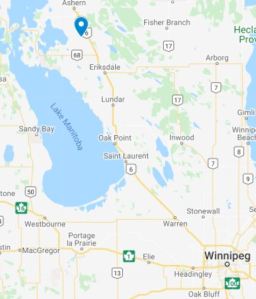
Map showing Winnipeg (bottom right) and the location of the Kelm homestead near Camper (top left)

When Robert Bergner arrived in Camper on June 13, 1910, to look for a homestead, “there was no town, only a few tents.” Though described as historically having been “an uninhabited wilderness” or having few permanent settlements by the late eighteenth century,[1] the Interlake region of Manitoba, between Lake Manitoba and Lake Winnipeg, was home to the Ojibway, Cree, and Oji-Cree, as well as the Metis.[2] From 1670 to 1869, the region was part of Rupert’s Land, which comprised eight million square kilometers and was monopolized by the Hudson’s Bay Company. In 1869, the Government of Canada purchased Rupert’s Land from the HBC, who claimed ownership, for 1.5 million dollars. The transfer was finalized in 1870, the same year Manitoba joined Canada.

Starting in 1871, the Government of Canada established townships in a grid system called the Dominion Land Survey. Beginning in 1872, The Dominion Land Act guided the administration of land for homesteading, among other uses. To boost prairie settlement, the government advertisement homesteads in 160-acre increments. After paying the ten-dollar application fee, the homesteader had three years to break and farm thirty acres of land, reside on the homestead for more than six months out of the year, and build a house and barn.[3] Once these requirements were fulfilled, the homesteader would receive the title for the land and, if he was not already a British subject, become naturalized.[4]

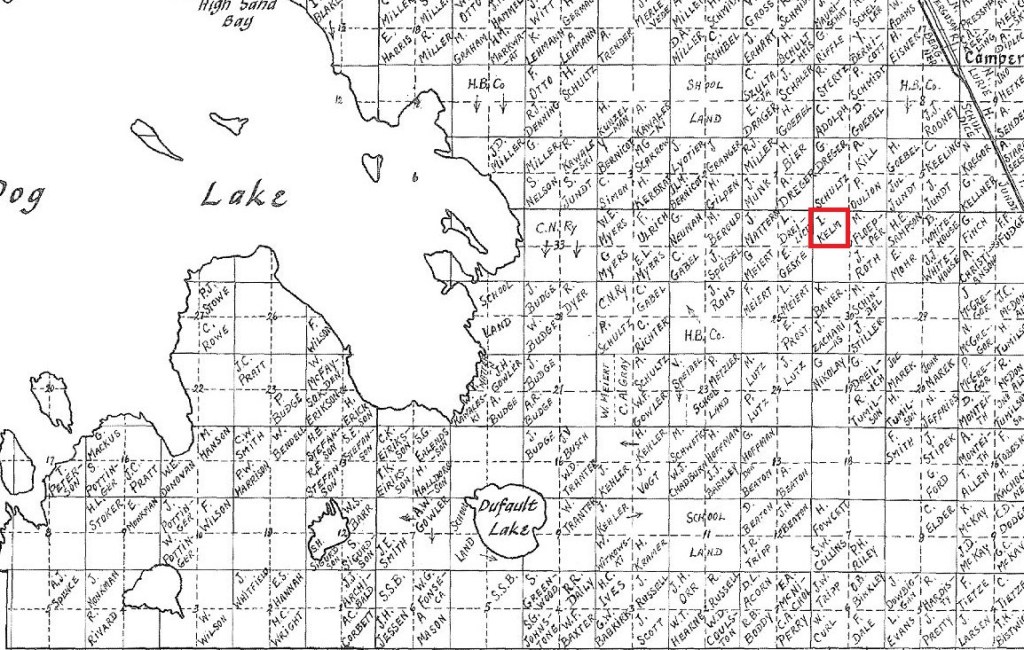
Julius Kelm applied to the Government of Canada for a homestead on May 1, 1911.[5] The 164 acres was located along what is now Edison Road, approximately halfway between Highway 6 and Dog Lake, and six kilometers from Camper.[6] According to an interview with Julius and Martha (see Stories From the Past), there were around twenty other German families living in the area around Camper. The majority of Germans settled north and east of Dog Lake and west of Camper: “Many of the later [German] settlers–from the Russian Ukraine–came to be near the earlier German settlers and took up stonier, more heavily-wooded land.”[7]

“[Julius Kelm entry in Homestead Grant Register, application for homestead 419750]” in Manitoba, Saskatchewan and Alberta, Canada, Homestead Grant Registers, 1872-1930, Library and Archives Canada, accessed 05 Jun 2021 through Ancestry

Julius likely traveled the 165 kilometers from Winnipeg to Camper alone to look at available land before applying for it. There were few roads during that time; scouting homesteaders only had “a map from the Land Titles Office, showing the township lines, which were just lines just cut through the bush; [they] walked through swamps waist deep in water.”[8] Julius would have returned to Winnipeg for his family. Anna Markwart recalls that, in 1909, the Markwart family “packed up their belongings, loaded them into a freight car and came by rail as far Camper [as] that was as far as the railway went at that time. They had to stay in the freight car while Henry [Markwart] walked seven miles [eleven kilometers] to the homestead to see if he could get the only neighbor to lend him a wagon to move the family to the new homestead.”[9] Julius had selected land “in the twenty-third township, in the sixth range, west of the principal meridian,” or homestead 419750.[10]

The first of the homesteading work occurred in early May. The land would have to be broken and ploughed first, and this was most effectively accomplished between June and August. Many accounts of homesteading in the Camper area begrudge the “mountains of stones”; in order for land to be cleared for farming, “stumps and stones” had to be removed and “every time the land was ploughed there would be more stones.”[11] After this, a house and stable would be built. Anna Markwart remembers that her husband’s family “lived in a makeshift shelter until they could cut enough logs for a small log house.”[12]

Homesteading on the prairie was often treacherous; wild animals harassed and feasted on livestock, even getting into the barns.[13] The year Julius secured his homestead, a timber, or grey, wolf was terrorizing livestock “from Camper to Gypsumville” and farmers would stay up at night with their guns waiting for it.[14] The prairie, immense and seemingly never-ending, could also be a lonely place. Debbie Hoffman describes her grandmother’s, Martha Miller’s, first years in her new home: “Martha wasn’t used to the big forests and swamps of the Interlakes […] The fright and loneliness almost drove her out of her mind.”[15]

Map of homesteads located within Township 23, east of Dog Lake. Julius Kelm’s neighbors included the Drailich family, whose daughter Adeline “Lena” married Edward Kelm, and Mattern and Geske families; courtesy of Taming a Wilderness: A History of Ashern and District by Ashern Historical Society

Julius and Martha had four children while living near Camper: Hannah (born March 4, 1913), Robert (born May 12, 1914), Hilda (born June 22, 1915), and Daniel (born May 17, 1917). The place of birth for the first three children is the Rural Municipality of Coldwell while the place of birth for Daniel is Camper.[16] In the 1916 Census of Canada, the family identified as Russian as World War One raged in Europe, the German families around them also identifying as Russian.[17] Julius (as John Kelm) also appears in the 1916 Census of Canada living with the Rempel family at 814 Bannatyne in Winnipeg as a lodger. He may have returned to Winnipeg for part of the year to find extra work to sustain his homestead.[18] Later that year, in December, the oldest daughter, Olga, thirteen years old, died. No record has been found of her death and burial.

It took Julius and Martha more than three years to earn their papers. Julius owned the land by February 15, 1917, when inspectors verified that he had fulfilled the requirements.[19] Sworn statements from two neighbors were required.[20] When his neighbor John Mattern, obtained the patents to his land on May 20, 1918, Julius testified: “Those that witnessed this were John Kelm of NW 31-23-6W and Edward Geske of SE 36-23-7W.”[21] In the 1921 Census of Canada, Julius is the owner of his three-room home.[22] 

[Homestead No. 419750 grant]” from Letters Patent, Canada, Department of the Interior, accessed 05 Jun 2021 through Canadiana Heritage

But farming proved to be too difficult; the Kelm family “had the worse land, unsuitable for farming” (see Stories From the Past). Frank Tennenhouse, whose family moved to Camper in 1911, writes that there was little government support for new farmers and there were few nearby farmers who had settled there long enough who could help newcomers.[23] Tennenhouse remembers that his father had “visited the location and had thought it was wonderful because there was plenty of hay for cattle and trees for wood. What he did now know was that the hay was low quality swamp and the soil was stony and infertile.”[24] Shannon Stunden writes, “Many […] newcomers settled in the less productive lands […] in eastern or interlake Manitoba.”[25] Most families returned to Winnipeg.


[1] James Morton Richtik, “A Historical Geography of the Interlake Area of Manitoba [thesis]” from Manitoba Heritage Theses, University of Manitoba, 1964, p14

[2] Government of Manitoba, “The First Peoples” [pamphlet], undated, accessed 13 Nov 2020, https://www.gov.mb.ca/chc/hrb/pdf/the_first_peoples.pdf

[3] “Manitoba Crown Land and Homestead Records (National Institute) [wiki]”, FamilySearch, 09 Oct 2018 [last edited], accessed 05 Jun 2021, https://www.familysearch.org/wiki/en/Manitoba_Crown_Land_and_Homestead_Records_(National_Institute)

[4] Ibid.

[5] “[Julius Kelm entry in Homestead Grant Register, application for homestead 419750]” in Manitoba, Saskatchewan and Alberta, Canada, Homestead Grant Registers, 1872-1930, Library and Archives Canada, accessed 05 Jun 2021 through Ancestry

[6] Manitoba Agricultural Services Corporation, “Land Parcel Corporation,” 2021 [copyright], accessed 05 Jun 2021, https://www.masc.mb.ca/masc.nsf/land_parcel_info.html

[7] Taming a Wilderness, p375; Richtik, p198-199

[8] Ibid.

[9] Taming a Wilderness, p190

[10] “[Homestead No. 419750 grant]” from Letters Patent, Canada, Department of the Interior, accessed 05 Jun 2021 through Canadiana Heritage

[11] Taming a Wilderness, p390, 401

[12] Taming a Wilderness, p190

[13] Dugald Women’s Institute, Springfield: 1st Rural Municipality in Manitoba, 1873-1973, Dugald, MB: Dugald Women’s Institute, 1974, p34, accessed through Internet Archive

[14] Interlake Pioneers, Hardship and Happiness, Steep Rock, MB: Interlake Pioneers, 1974, p64

[15] Taming of a Wilderness, p382

[16] “[Harma [Hannah] Kelm, Robert Kelm, Hilda Kelm, Daniel Kelm birth information]” in Manitoba Vital Statistics Agency database index, accessed 06 Jun 2021

[17] 1916 Census of Canada, Library and Archives Canada, accessed 08 Jun 2021 through Ancestry

[18] Taming the Wilderness, p373

[19] “[Homestead No. 419750 grant]” from Letters Patent, Canada, Department of the Interior, accessed 05 Jun 2021 through Canadiana Heritage; the stamp in the homestead grant register indicates February 7, 1917

[20] “Manitoba Crown Land and Homestead Records (National Institute) [wiki]”

[21] Ashern Historical Society: The Next Chapter; A History of Ashern and District, Ashern, MB: Ashern Historical Society, 2008, p319, accessed 06 Jun 2021 through University of Manitoba Digital Collections

[22] 1921 Census of Canada, Library and Archives Canada, accessed 08 Jun 2021 through Ancestry

[23] Frank Tennenhouse, “Photocopy of unpublished manuscript, “Seventy Five Years of Farming in Manitoba: A Collection of Stories of Life on the Farm from Two Generations of the Tennenhouse Family,” Tennenhouse Family fonds, University of Manitoba Archives, accessed 06 Jun 2021 through University of Manitoba Digital Collections

[24] Ibid.

[25] Shannon Stunden Bower, Wet Prairie: People, Land, and Water in Agricultural Manitoba, Vancouver: University of British Columbia Press, 2011, p35, accessed 08 Jun through Google Books

Ed and Lena Kelm in “Footsteps through the Years”

The University of Manitoba Digital Collections is a good resource for digitized Manitoba history. Among their local history books is Footsteps through the Years, which mentions Edward and Lena Kelm (Edward is the son of Julius and Martha Kelm). Click the URL in the citation after the transcription below if you would like to view the original.

“Kelms 1938-1958

Ed bought a farm in Marquette in 1938. During the summers of 1938-38 and 40 acres of land was broken [sic], crops sowed and harvested with the Becker brothers. Ed’s winters were spent working in the mine at Creighton, Ontario.

January 31, 1942 Ed married Lena Drailick of Camper. The newlyweds arrived in Marquette on the night train Feb. 6 1942. After having dinner at Charlie Ursels they were driven to their farm.

Ed and Lea have four children, all born during their years at Marquette.

Joyce married Maurice Hamonie in 1969. They reside in Headingly and Joyce teaches school in Winnipeg.

Ernie married Yvette Beaudin of Montreal in 1969. Ernie works for the External Affairs Dept. in Ottawa and he and his family have resided mainly in Switzerland and Israel. They have two sons born in Tel Aviv, Israel. They returned to Ottawa, Ontario in 1975.

Kenneth resides in Winnipeg doing construction work.

Bettyann graduated from the U. of M. in Home Economics and is presently enrolled in the Education Dep. of the University of Edmonton, Alberta.

The Kelm family moved from Marquette with the help of Douglas Strachan and Chas. Slocombe, on September 14, 1958. They have many memories of the little “white” school, Ed’s Sayer Creck fishing days with Bill Maltby and Bill Kulezycki and the winter spent in the bush (1946-47) at the Lakehead with Mike Wallace, also of Marquette.

Ed retired on Feb. 12, 1976 but kept busy. Presently he is planning to build a cabin at Waterhen this summer. Fishing still takes up many summer weekends.

Lena continues to work at Canada Packers. Traveling to see her grandchildren has been her hobby for the last five years.”

Marquette and District Historical Guild. Footsteps through the Years: Ossowa, Reaburn, Marquette, Meadow Lea, Poplar Heights. Marquette: Marquette and District Historical Guild, [late 1970s]. Retrieved 18 Apr 2019 from University of Manitoba Digital Collections, http://hdl.handle.net/10719/2264425