Happy New Year. Thank you to everybody who took the time to leave a comment or connected with me through email last year. My sincerest apologies if I have forgotten to respond. I blame the two small children in my house for my forgetfulness. If it was a inquiry about whether your Kelm family is related to mine, I likely set the email aside to investigate and then did not have the time to actually do that. You are welcome to remind me.
Return to Winnipeg
The story of how my great-grandparents, Julius (John) and Martha Kelm moved from Winnipeg to their homestead near Camper can be found here: Homesteading Near Camper, Manitoba, 1911-1921. This blog entry speculates about their return to Winnipeg after a decade homesteading on the prairie. I do not know their personal account except that they “had the worse land, unsuitable for farming” (see Stories From the Past). Their story follows the trajectory of many other homesteaders around Camper, so I thought I would explore other accounts.
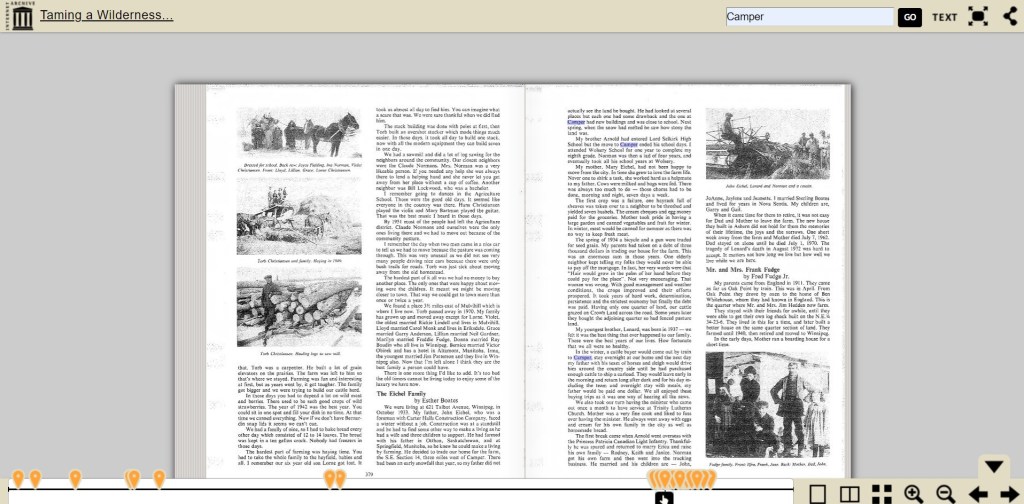
For this blog entry, I found the University of Manitoba Library’s Digital Collections (especially their Manitoba Local Histories collection) very helpful. Taming a Wilderness: A History of Ashern and District contained a wealth of information and I enjoyed reading the accounts of those who homesteaded near Camper. I had a free trial of Newspapers.com and searched Winnipeg newspapers (you can access The Winnipeg Tribune for free through U of M) for significant events around the time my great-grandparents left their homestead and returned to Winnipeg. Once I found a story to run with, I checked it against local history books. If you click into a digitized book, you can search for keywords (see below).
Julius and Martha returned to Winnipeg between 1921, when the 1921 Census of Canada recorded them living near Camper, to 1924, when the obituary for Martha’s brother, Christian Kirsch, references her living in Winnipeg.[1] Between 1920 and 1923, bad harvests and falling wheat prices caused economic hardship for many Manitoba farmers and there was an exodus.[2] According to a Maclean’s article published February 1, 1922, “The high cost of producing and marketing the crop, with the heavy drop in prices, […] was responsible for the depression not only felt in Western Canada but reflected in every trade and industry in the Dominion.”[3]
Homesteaders often faced the devastation of fire, but, according to Borghil Olson, whose family homesteaded near Camper, one particular fire that “raged for weeks” caused many to grow restless and leave.[4] In August of 1920, a massive brush fire engulfed the Interlake region. Although the fire caused the most damage around where it originated near Mulville, about fourteen kilometers south of Camper, it had burned north through Camper and Ashern, driven by the season’s lack of rain. Newspapers described the fire’s arrival in Camper: “At Camper a stable and boarding house had been burnt down. The post office caught fire three times but was saved.”[5] In nearby Ashern, “chickens and calves had been roasted alive in the farmyards, and practically all crops destroyed.”[6]
“In 1920 the area was pretty well wiped out by bush fires, which raged for weeks. It was a very dry year, farmers lost most if not all the hay they had for winter as well as the spruce trees that could have been used for lumber. A terrifying experience. I recall we took all the children to Martin Johnson’s place where we figured they were safe from the fire. Mrs. Ben Kristianson and Mrs. Stein looked after the children, did the cooking, etc., while Mrs. Martin and I were out helping the men folk to save our homes and grain fields. Ben Kristianson’s home was a mile away from ours, and he made an agreement with the rest of the men, that if the fire did reach the spruce bluff near his home he would fire a rifle, and this would be a signal for the others to come to help fight fire. This particular day we were having lunch when a gun shot was heard, one of the women said “Ben must have shot a deer.” The men knew better, one by one they took off, to find Ben throwing water from a barrel alongside his house, onto the roof to put out the sparks flying from the spruce bluff close by, this way they did manage to save the home.”[7] – Borghild Olson, from Taming a Wilderness
In the 1926 Census of Manitoba, Saskatchewan and Alberta, the Kelm family except for the oldest son, William, were enumerated at 557 Armetta Avenue in the municipality of West Kildonan. In December of 1929, the “two blocks [of Armetta Avenue] west of McGregor Street, which included the Kelm home, prepared a petition to join the city of Winnipeg in order to obtain sewer service.[8] Armetta Street would later be renamed Matheson Avenue.[9] Julius and Martha would live at 557 Matheson Avenue for the rest of their lives.
Julius died February 27, 1959, at the Concordia Hospital, and is buried in Glen Eden Memorial Gardens in West Saint Paul, north of Winnipeg.[10] He was eighty years old. Martha became a member of the Mountain and Andrews Seventh-Day Adventist Church. She died at the St Boniface Hospital on July 20, 1965, at the age of eighty-four.[11] She is buried with her husband.


[1] “Christian Kirsch obituary,” 1924, newspaper source unknown, emailed 04 Oct 2024 by J. Hill
[2] Gerhard P. Bassler, The German Canadians, 1750-1937: Immigration, Settlement and Culture (St. John’s, NL: Jesperson Press, 1986), p99
[3] Jenkins, Charles Christopher, “The West Won’t Stay Down!,” 01 Feb 1922, from Maclean’s [magazine], accessed 21 Dec 2021 through https://archive.macleans.ca/article/1922/2/1/the-west-wont-stay-down [note: URL does not seem to be working any longer; access only through paywall (10 Jan 2024)]
[4] Borghild Olson, “Homestead Days,” from Taming a Wilderness: A History of Ashern and District Canadians (Ashern, MB: Ashern Historical Society, 1976), p84. Retrieved 09 Jan 2024 through University of Manitoba Digital Collections, http://hdl.handle.net/10719/2276635
[5] Free Press Prairie Farmer, 25 Jul 1920, accessed 22 Oct 24 through Newspapers.com
[6] Ibid.
[7] Olson, p84
[8] Winnipeg Tribune, 17 Dec 1929, accessed 22 Oct 2024 through Newspapers.com
[9] Manitoba Historical Society, “History in Winnipeg Streets,” 29 Sep 2024 [last revised], from Manitoba Historical Society Archives, accessed 10 Jan 2025 through http://www.mhs.mb.ca/docs/winnipegstreets/index.shtml#m
[10] “KELM,” Winnipeg Evening Tribune, 28 Feb 1959, accessed 18 Apr 2019 through University of Manitoba Digital Collections, http://hdl.handle.net/10719/1934469
[11] “MARTHA KELM,” Winnipeg Evening Tribune, 21 Jul 1965. Retrieved 18 Apr 2019 from University of Manitoba Digital Collections, http://hdl.handle.net/10719/2042634/


 Kelm History Blog